













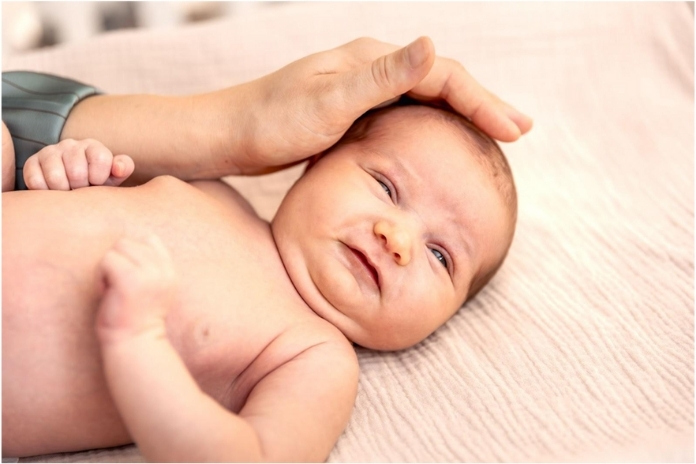
A Common (and Often Harmless) Baby Habit
Babies are full of little quirks that make parents wonder: “Is the baby’s head movement normal or should I worry?” One of those quirks is when a baby starts shaking their head side to side – a movement you might see when your child is lying down, playing, or even just dozing off.
You’ll often start noticing this kind of head movement around 3 to 6 months, as babies begin to get stronger and more in control of their head and neck. Sometimes it’s just playful, calming, or part of how they explore the world – though in some cases, it might point to something a little more concerning.
In this post, I’ll walk you through this habit in detail. Let’s dive in – you might find you already underestimated how much thought your baby puts into moving that tiny head!
Normal Reasons Why Babies Shake Their Heads
When head-shaking is part of normal growth, it often reflects a baby learning about their own body and senses. Here are some of the “good” reasons.
1. Developing Motor Control
Between about 3-5 months, babies begin to strengthen and coordinate neck, shoulder, and back muscles. As they experiment with turning, rolling, and lifting their heads, the side-to-side shake is a natural “practice move.”
In effect, your baby is asking: “How far can I twist? How much force can I use? How stable can I keep my head?” Even if it looks repetitive or odd, it’s often just babies exercising motor control.
Also, developmental studies have shown that it’s normal for babies to do repetitive or rhythmic movements with their arms or legs. It’s a part of how their brain and body learn to work together. (For example, babies often steadily move their arms during play, and over time, they get better at controlling those movements.)
2. Communication, Exploration, and Gestural Play
Babies imitate things earlier than we imagine. Even before they understand “no,” they watch faces, head gestures, and body language. Sometimes, baby head shaking means their early symbolic experiment – “Let me try that gesture.”
In mother-child play studies, spontaneous head nodding or shaking emerges in early interactions – babies begin to try gestural patterns even before consistent speech.
When a baby’s head shaking side to side occurs with smiles, cooing, or eye contact, that’s a hint it’s exploratory/communicative rather than reflexive.
3. Self-Soothing or Sleep Preparation
Here’s one you might recognize: your baby starts shaking or gently rocking their head just before falling asleep. It’s like their own built-in lullaby, a little motion to lull themselves into rest.
If you’ve seen them rub their eyes, suck a thumb, or quietly shift other limbs just before nodding off, head movement may just join the “pre-sleep ritual.”
Some rhythmic head motions during early sleep phases are part of benign movement behaviors that many kids grow out of.
4. Response to Sounds, Textures, Light – Sensory Feedback
Babies are sensory sponges. A sudden sound, light change, or new texture may prompt a head shake as their ears, eyes, or skin register new stimuli.
This is part of a baby’s sensory development – a way for them to orient, test, and learn what kind of input their head/neck receives.
In fact, some literature describes vestibular self-stimulation (i.e., inner ear/balance feedback-seeking) as one possible explanation for repetitive head movements in infants.
So, a baby hears a strange squeak, and their head tilt and shake are part of scanning and learning.
Read More: Why Some Babies Fight Sleep Even When They’re Tired: Causes & Soothing Solutions for…
When Head Shaking Might Signal a Problem
While for most babies, head shaking side to side is benign and developmental, a few red flags suggest it’s time to consult a pediatrician. Let’s see what they are.
1. Ear Infection, Discomfort, or Pain
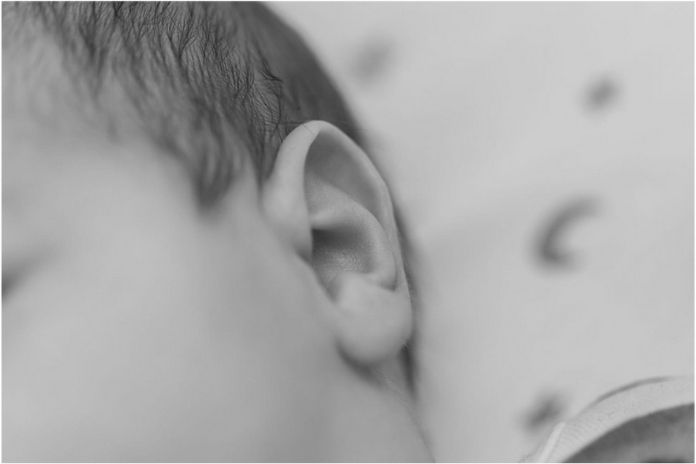
Babies can’t tell us an ear hurts, but repeated, forceful head shaking combined with ear rubbing or tugging is a classic sign of ear trouble.
Other signs of a baby’s ear infection to watch for:
- Fever, especially with cold symptoms
- Fussiness, especially when lying down
- Disturbed sleep
- Discharge or visible inflammation near the ears
If head shakes increase during or following a cold or middle-ear infection, that’s a clue.
2. Neurological or Developmental Concerns
If the motion becomes persistent, rhythmic, almost “mechanical”, and happens throughout the day – especially without social interaction, face contact, or response to name – it might suggest more.
In medical literature, persistent figure-8 or side-to-side head shaking sometimes appears in children with repetitive movement disorders, neural conditions, or even early signs of autism spectrum behaviors.
There is also a phenomenon called shuddering attacks – brief, involuntary head tremors – which are usually benign (non-epileptic) and not associated with changes in consciousness.
If the baby is not meeting other developmental milestones (e.g., eye contact, responding to name, babbling, reaching), then head shaking side to side, combined with those delays, is more concerning.
3. Vision or Vestibular/Balance Issues
Frequent head motion could point to vestibular imbalance or inner-ear / brainstem issues – for example, some infants with nystagmus or inner ear problems display abnormal head tilting or shaking to compensate.
While rare, when head movements are persistent and paired with signs like poor tracking of objects, unusual eye movements, or absence of the baby’s head control, evaluation by a pediatric neurologist/ENT may be needed.
4. Sleep-Related Rhythmic Movement Disorders
If your baby is shaking their head while sleeping, during bedtime, or even before sleep – especially along with things like body rocking or head banging – it could be part of something called rhythmic movement disorders (RMDs).
In most children, such sleep movements are benign and tend to fade over time. But in rare cases, they may persist or interfere with rest.
Read More: Newborn Slept 6–7 Hours Without Feeding: Is It Normal? What Experts Say
When to Call Your Pediatrician
Here are solid “if this is happening, then talk to a doctor” rules of thumb:
- If the baby’s head shaking side to side is very frequent, abrupt, or forceful enough to disrupt sleep or feeding.
- When it’s paired with a lack of eye contact, no response to name, delayed babbling, or motor milestones.
- If you see ear-pulling, fever, discharge from the ears, or signs of infection.
- If you see head banging, stiffening, arching of the back, or strange body postures during shake episodes.
- If the behavior worsens over time instead of gradually decreasing.
Pediatrician, Suzanne B. Haney, also cautions that when a baby is shaken violently or experiences impact to the head, it can result in serious brain injury – a condition known as abusive head trauma.
Even if in doubt, a well-baby check or a short video of the behavior can help your pediatrician decide if further referral is needed.
Read More: The Best Natural Remedies for Baby Gas and Colic Relief (Backed by Science &...
What You Can Do at Home (Before or While You Seek Advice)
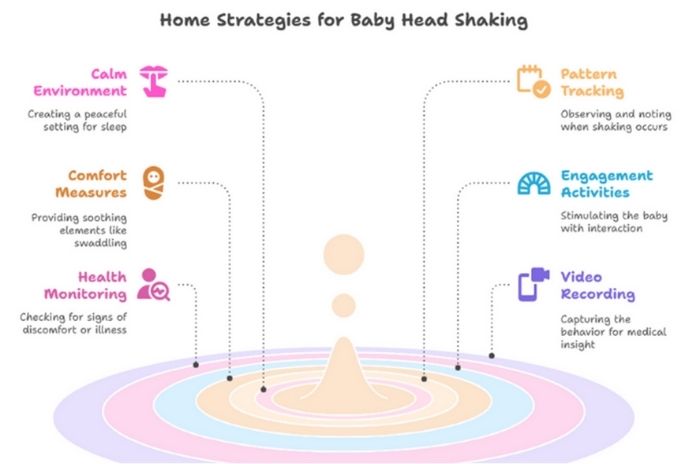
You don’t always need to intervene aggressively – but you can do some gentle monitoring and supportive changes.
- Keep things calm around nap/sleep time: Dim lights, minimal noise, fewer sudden movements. Let the head shaking be a part of winding down.
- Note patterns: Just jot down when it happens – time, how long, what was going on at that time (like lights, noise, tiredness), and if the baby just ate or napped. It helps spot any triggers.
- Offer comfort: Try gentle swaddling (if baby’s still small), soft white noise, rocking, or a pacifier. Don’t force the shaking to stop – that might stress them more.
- Keep baby engaged: Talk, sing, play little games, or change their view. Face-to-face time often helps reduce these movements.
- Monitor ears and health: If the baby has a cold or ear infection, be alert to signs of discomfort. Consult a pediatric healthcare provider early for possible ear evaluation.
- Record a video: Sometimes showing your pediatrician a short, clear video of the head shaking behavior (with audio context) gives far more insight than describing it.
Read More: How to Get Your Toddler to Stay in Bed: Proven Tips for Peaceful Bedtimes
Key Takeaway
Most often, a baby shaking their head side to side is a quirky, normal, as well as harmless behavior – part of their developmental journey of learning balance, motor skills, and sensory feedback. But the same shaking can also mean that the baby is not feeling OK – maybe because of an ear problem, could also be a neurological or sensory issue. So, it’s better to watch closely.
If the head shaking is repetitive, interfering with feeding or sleep, or paired with other concerning signs, getting professional input is the safest choice.
FAQs
Q1. Why is my baby shaking its head left and right?
This one is mostly normal. Babies can usually do things like this to feel their own body, or maybe just for soothing. Sometimes babies do this when they are sleepy or happy. But if the baby is doing too much or very strong shaking, then it’s better to keep an eye and maybe consult a doctor too.
Q2. Baby shakes head side to side (very hard) to fall asleep – is that okay?
If it’s gentle or rhythmic and doesn’t hurt, it can be a private “lullaby move.” But if it’s jerky, loud, or shakes the bed and disturbs sleep or sounds like convulsions, better to have it checked.
Q3. Could head shaking be related to autism in infants?
Only head shaking never tells about autism signs in infants. You should see other signs also – the baby avoids eye contact, does not see when called by their name, does not play or smile much, and even has delayed milestones – if the baby shows all these signs, then you must show the child to the doctor.
Q4. Does head shaking mean the baby has autism?
That’s a red flag. Monitor carefully, video it, and consult a pediatrician. Worsening or increasing frequency suggests you need evaluation.
Q5. Can ear infections cause head shaking only sometimes?
Yes – ear pain or fluid buildup sometimes makes babies shake or tilt their heads to ease pressure. If the head movement comes along with pulling ears, fever, or irritability, an ENT check could be helpful.
References
- https://my.clevelandclinic.org/health/diseases/14305-head-banging-and-body-rocking
- https://www.frontiersin.org/journals/psychology/articles/10.3389/fpsyg.2022.896319/full
- https://journals.sagepub.com/doi/abs/10.1177/0142723711419326
- https://pmc.ncbi.nlm.nih.gov/articles/PMC5510988/
- https://www.ncbi.nlm.nih.gov/books/NBK279381/
- https://pmc.ncbi.nlm.nih.gov/articles/PMC5510988/
- https://pmc.ncbi.nlm.nih.gov/articles/PMC8324121/
In this Article