














Walking speed can provide more insight into our health than our body weight alone. Walking is that one exercise that truly deserves its dazzling health halo. This low-impact workout breaks up the dreaded idle period. This free activity can aid in weight management, lower the risk of diabetes, and boost heart health.
You might not realize it when trying to reach your daily step goal, but our walking speed also serves as a vital sign.
There is more to this connection than meets the eye. Walking is a good indicator of general vitality since it involves the cooperation of several systems, including your heart, lungs, muscles, joints, and brain.
Walking—or gait—speed is “a powerful indicator of vitality,” says Stephanie Studenski, a professor at the University of Pittsburgh’s Division of Geriatric Medicine and co-author of the new analysis. “We just didn’t use it in health care or public health.”
This article will discuss the intriguing science underlying walking speed as a health indicator, why it’s more important than you may imagine, and provide valuable tips for increasing it.
Read More: Benefits of Walking For Diabetes
Why Walking Speed Is Considered a ‘Vital Sign’
Everybody has had their vital signs taken on a visit to the doctor. During a routine visit, healthcare providers measure five essential signs: blood pressure, heart rate, breathing rate, body weight, and body temperature. These vital indicators gauge our health and the necessity for medical intervention. However, have you ever heard of assessing your health by the pace at which you walk?
According to Dr. Marie Therese Kanagie-McAleese, a physician at the University of Maryland Upper Chesapeake Medical Center, vital signs “provide information on the basic physiologic functioning of the body.”
It’s something doctors look at during an annual check-up, such as your body temperature, pulse rate, respiration rate, and blood pressure. Oxygen saturation, which measures how much oxygen your blood is carrying, is also often included, as is weight, albeit not without some controversy.
Often called the “functional” vital sign, walking speed serves as a reliable measure of an individual’s mobility and physical function.
There is more to walking speed than how quickly one gets from one place to another. This indication, which reflects the cardiovascular, pulmonary, musculoskeletal, and neurological systems of your body, can be used to predict frailty, fall risk, total functional deterioration, and the possibility of future hospitalization or institutionalization.
A 2020 study found that men walk a little faster than women, and that walking speed is influenced by both biological sex and age. On average, individuals who are under 30 walk at a pace of about 3 mph. For people aged 30–39 and 40–49, the typical speed is around 2.8 mph.
Those in their 50s generally move at about 2.75 mph, while individuals over 60 average 2.7 mph. After the age of 65, an average walking speed drops to roughly 2.1 mph.
Gait speed is a key indicator of future health since walking uses several bodily systems, including the heart, lungs, muscles, and neurological system. Any slowing might be a warning sign of deteriorating health.
The Research: Walking Speed and Longevity

Numerous studies conducted in the last ten years have demonstrated a high correlation between life expectancy and walking pace. Health professionals typically recommend that adults get 150 minutes of moderate exercise each week for optimal benefits. If committing to that amount feels challenging, brisk walking for just 15 minutes daily can offer similar health rewards. Individuals who walk more quickly by nature typically have stronger muscles, improved cardiovascular fitness, and improved cognitive function—all of which are protective factors against chronic illness.
We know “fast walking is good compared to slow walking,” but there isn’t much research on how many minutes you should spend fast walking on average, said Dr. Wei Zheng, director of the Vanderbilt Epidemiology Center and the Anne Potter Wilson Professor in Medicine at Vanderbilt University Medical Center in Nashville, Tennessee.
Walking speed is a reliable indicator of our health, according to numerous studies. But why is gait so crucial? The simplest explanation is that being able to walk more quickly is a sign of being in good physical condition.
According to Dr. Anthony Giuffrida, a specialist in interventional spine and pain management at the Cantor Spine Center in Florida, those who walk quickly show “strong muscle strength, coordination and neuromuscular function,” as well as “efficient heart and lung function.”
Read More: Elephant Walk Exercise: The Stretch That Loosens Tight Hamstrings Fast
Health Factors: Walking Speed Can Reflect
Walking speed measures more than just the speed of motion; it is an indication of how well your body functions, in general. People refer to a person’s regular pace of walking as their walking speed. Walking speed is a measure of how efficiently the body moves, expressed in meters per second.
Increased Cardiovascular Endurance: When walking speed increases, oxygen must be supplied to the muscles more quickly, requiring the heart and lungs to work more efficiently.
Increased Muscular Strength and Joint Range of Movement: More time to increase the speed of walking requires stronger muscles and flexible joints.
Improved Balance and Coordination: Maintaining a steady, comfortable walk at a quicker pace requires proprioception (awareness of the body’s location and movement) and a healthy neurological system.
Cognitive Performance: Memory, cognition, and coordination of movements are essential for motor control, and walking speed may indicate cognitive performance.
Metabolic health: Walking speed is also related to metabolic activity. Slower walking speed has correlated with increased type 2 diabetic cases and struggles maintaining weight.
In addition to these benefits, walking speed is being studied and used as a predictor of longevity. Higher speed of walking is a simple but effective indicator of general vitality, and multiple studies have identified correlations between longer and healthier lives and higher walking speed.
What’s Considered a ‘Normal’ Walking Speed?

Walking offers numerous health benefits and can be an excellent activity for achieving weight loss goals or enhancing overall wellness. Adults typically walk between 2.5 and 4 miles per hour, according to the Centers for Disease Control and Prevention (CDC).
To find out how long it takes an average person to walk a mile, let’s examine the average human walking speed range, which is 2.5 to 4 miles per hour.
At the slower end of these average walking speeds, covering a mile would take about 24 minutes. It is a comfortable, conversational walking pace for the majority of people.
On the other extreme, a mile would take fifteen minutes to walk at a quick pace of four miles per hour. An average walking speed of 997 middle-aged walkers (45 years old) was 1.30 m/s for their typical gait and 1.99 m/s for their maximal gait, according to a study.
Read More: The Power of “Awe Walks” – How Experiencing Wonder Can Reduce Stress
How to Measure Your Walking Speed at Home
At-home walking speed measurement is easy, quick, and requires little equipment. The following is a detailed guide for a 6- or 10-meter walk test:
- Whether indoors or out, pick a level, obstacle-free path. Using tape, cones, or any other visible marker, clearly define the start and finish lines six or ten meters apart.
- Determine how fast you can walk comfortably at a typical, leisurely pace. Ask someone to keep track of your time from the start to the finish line. For the most precise outcome, perform the test three times and calculate the average of the recorded times. Don’t walk any faster or slower than you usually do.
- The maximal walking speed test measures your fastest safe walking speed, such as when crossing a roadway. Walk carefully at first, then quickly before the timed area. For accurate results, walk through it as soon as you can, slow down after finishing, and repeat the process three times.
- If you walk more slowly than usual, see a doctor or physical therapist. Walking speed is a reflection of how the body functions generally. Physical therapy can assist in increasing strength, coordination, and endurance, which will eventually promote safer and more efficient walking. Abnormal results don’t indicate you can’t get better.
How to Improve Your Walking Speed (and Health)
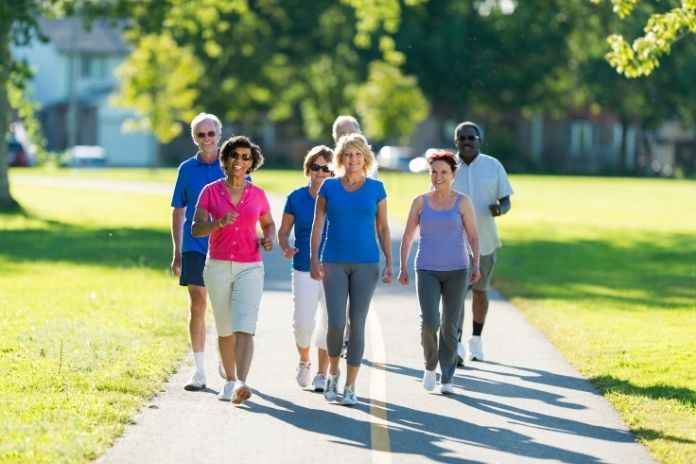
Walking faster is better for mobility and health. To get your walking speed up, you can do the following beneficial exercises and activities at home:
Resistance Training: The more strength you have, particularly in your legs, the faster you will walk. You can strengthen your walking muscles with exercises like sitting, standing to a chair, and heel lifts at the kitchen countertop. Aim to do these kinds of exercises two or more days a week.
Balance Training: To walk quickly and safely, you need reasonable balance. You can practice your balance with activities like tai chi, a heel-to-toe walk, or standing on one leg. Your balance training will make you walk faster and reduce your risk of falling.
Aerobic Workouts: From a health and endurance standpoint, your cardiovascular system needs to be in good shape to establish a proper walking pace. Aerobic workouts can help you establish that endurance in your walking, and can include activities like brisk walking, cycling, swimming, etc. The goal should be to perform at least 150 minutes of moderate aerobic exercise in a week (20-25 minutes every day).
Use your Daily Life to Motivate Movement: Incorporate activity into your daily routines. Use your breaks to take a short walk, have walking meetings rather than sitting down, and take the stairs instead of the elevator. Incrementally, daily movements and exercise will improve walking speed, maintain cardiovascular health, and improve muscle function.
When to See a Doctor
Your age or fitness level might gradually change your walking speed, but you should not disregard an abrupt or noticeable drop. A sudden decrease in your gait speed may indicate an underlying medical issue that needs immediate attention.
If you experience additional symptoms, such as weakness, numbness, lightheadedness, or chronic pain in the legs, hips, or back, and notice slower walking, pay close attention to these symptoms. These symptoms might point to anything from cardiovascular disorders or musculoskeletal trauma to neurological disorders like peripheral neuropathy or stroke.
Frequent tripping, losing balance, or having trouble coordinating steps signals the need for evaluation. An early medical evaluation can also assist in determining the cause, preventing any falls, and starting the therapy as soon as possible to regain mobility.
Read More: Color Walk Therapy: How Walking with Colors Can Boost Your Mood and Creativity
Conclusion
Walking speed provides a valuable insight into our general health, and it is more than just a straightforward indicator of our fitness. In contrast to weight or BMI, gait speed provides essential information about cardiovascular, neurological, and metabolic health, as it represents the combined activity of the heart, lungs, muscles, joints, and nervous system.
Even little increases in walking pace can have a significant impact. Stronger muscles, improved balance, and increased endurance are all supported by better, more efficient walking, and these factors lower the risk of falls, chronic illnesses, and mobility impairments. Faster walkers typically lead longer, healthier, and more independent lives.
References
- https://www.scientificamerican.com/article/walking-speed-survival/
- https://www.yahoo.com/lifestyle/walking-speed-tell-health-155804700.html
- https://edition.cnn.com/2025/08/11/health/walking-fast-benefits-study-wellness
- https://health.usnews.com/doctors/stephanie-studenski-10983
- https://www.gaylord.org/patients-families/about/news/news-list/walking-speed-the-sixth-vital-sign
- https://ent-md.com/news/the-6th-vital-sign-walking-speed/
- https://www.umms.org/find-a-doctor/profiles/dr-marie-therese-kanagie-mcaleese-md-1689734188
- https://www.researchgate.net/publication/344166318_Walkability_Index_for_Elderly_Health_A_Proposal
- https://www.ideafit.com/increasing-walking-speed-and-step-count-for-longevity/
- https://pmc.ncbi.nlm.nih.gov/articles/PMC4254896/
- https://cantorspinecenter.com/staff/anthony-giuffrida/
- https://medicine.vumc.org/department-directory/Wei-Zheng
- https://health.clevelandclinic.org/your-walking-speed-may-be-linked-to-risk-of-heart-disease
- https://www.cypresshometherapy.com/walking-speed-a-functional-indicator-of-health-longevity/
- https://www.medicalnewstoday.com/articles/average-walking-speed#average-speed-by-sex
- https://marathonhandbook.com/average-walking-speed/
- https://www.wikihow.fitness/Measure-Your-Gait-Speed
- https://www.hingehealth.com/resources/articles/what-is-brisk-walking/
In this Article