












October marks National ADHD Awareness Month, observed every year from October 1–31. It’s a time to highlight both awareness and action for the millions of adults living with ADHD. While awareness campaigns focus on education, many adults still struggle with translating that knowledge into day-to-day functional life strategies.
About 4–5% of American adults (over 10 million people) live with ADHD, according to the CDC, yet most resources stop at describing symptoms rather than explaining how to work with an ADHD brain.
This article bridges that gap. It explores science-backed, practical strategies rooted in executive function research and neuroscience, routines, organization systems, and emotional tools that make daily life smoother.
Let’s explore the evidence-based methods that transform everyday life for adults managing this neurodevelopmental condition.
Understanding Executive Function and ADHD
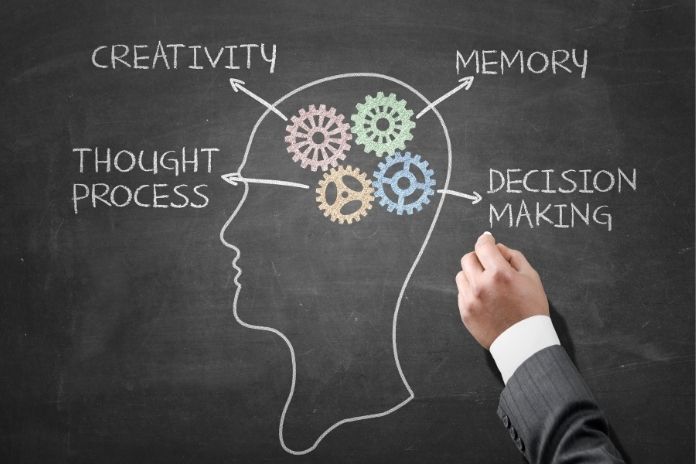
At its core, ADHD isn’t about effort or discipline; it’s about differences in executive function, the brain’s management system for organizing, prioritizing, and following through on daily tasks.
According to ADDitude Magazine, Dr. Russell Barkley explains that people with ADHD are often 30 to 40 percent delayed in the development of executive functions compared to their peers. This delay reflects the slower maturation of the prefrontal cortex, the part of the brain responsible for planning, self-regulation, and goal-directed behavior.
Because ADHD affects how dopamine is regulated in the brain, motivation and reward processing also differ. That’s why typical advice like “just start” or “try harder” rarely works. The ADHD brain needs structure that externalizes memory, time, and motivation.
Understanding this turns ADHD management from a willpower battle into a neuroscience problem with practical solutions. Now that we understand the neurological basis, let’s explore how to build systems that work with, not against, the ADHD brain.
Read More: Understanding ADHD: National ADHD Awareness Month
Building ADHD-Friendly Daily Routines
 Living with ADHD often means your days can swing between hyperfocus and chaos. The key isn’t forcing discipline, it’s designing rhythm. A well-built routine turns everyday tasks into automatic cues, freeing your brain from constant decision-making. Think of it as creating rails for your attention so it moves smoothly instead of derailing every few hours.
Why Routines Work for ADHD Brains
If you’ve ever tried to just “will” yourself into a schedule, you know it rarely sticks. That’s because ADHD brains thrive on predictability and reward, not sheer willpower. Let’s see how routines can be set up to actually work with your brain.
Routines aren’t boring; they’re liberation from decision fatigue. People with ADHD burn more mental energy on daily choices because every task demands a conscious restart. Research shows that creating structured routines helps cut down on decision fatigue by reducing the number of small choices you make each day.
This frees up mental energy and cognitive bandwidth for tasks that actually require focus and creativity. Experts note that consistent habits automate low-value decisions, allowing your brain to stay sharp for high-level thinking.
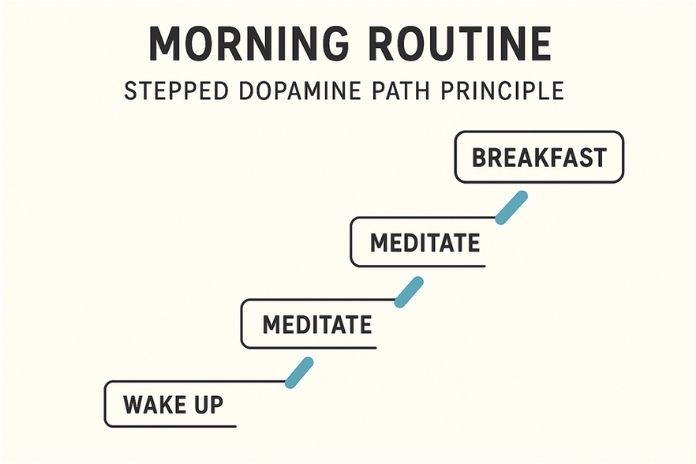
Predictable patterns also help the ADHD brain regulate dopamine. Each completed step delivers a small reward, creating what’s known as a “stepped dopamine path”, small hits of satisfaction that sustain motivation through longer tasks.
A useful structure:
- Start your morning with quick, achievable actions, hydration, sunlight, or a 3-minute tidying task.
- “Chunk” similar tasks together to reduce context-switching.
- Anchor new habits to old ones (for example, “after coffee, review my priorities”).
These steps build predictable external triggers that stabilize focus and minimize overwhelm.
In short, routines don’t restrict ADHD brains; they remove friction so your energy goes toward doing, not deciding. Effective routines start with understanding your energy patterns and building structure around them.
Practical Organization Strategies That Actually Work

Organization isn’t about perfection; it’s about designing a system your brain can trust. For ADHD minds, clutter and forgotten tasks aren’t signs of laziness; they’re signs of cognitive overload. The fix isn’t trying harder, it’s thinking smarter, by moving key information out of your head and into reliable external systems that do the remembering for you.
External Memory Systems
Struggling to remember everything? That’s your working memory hitting its limit. External systems aren’t crutches; they’re extensions of your brain that help you get things done without constant mental strain.
If you have ADHD, working memory isn’t unreliable; it’s limited. Expecting to remember everything internally sets you up for stress. Instead, build what psychologist Russell Barkley calls “external memory scaffolds.” These are physical or digital systems that act as extensions of your brain.
Here’s how to structure them:
- Digital reminders: Two notifications per task, one as a planning cue, one just before execution. According to ADDitude Magazine, external reminders cut missed appointments by up to 60%.
- Physical visual cues: Keep visible signals in your environment, sticky notes, labeled bins, and whiteboards.
- Color-coding: Limit yourself to three core colors (urgent, this week, reference). Too many add processing load.
- Daily 15-minute reset: Spend a few minutes at the same time every day resetting your physical or digital workspace.
These small structures offload the burden on working memory, letting your mind focus on action rather than recall. Beyond physical organization, managing time presents unique challenges for ADHD brains due to a phenomenon called time blindness.
Mastering Time Management with Time Blindness
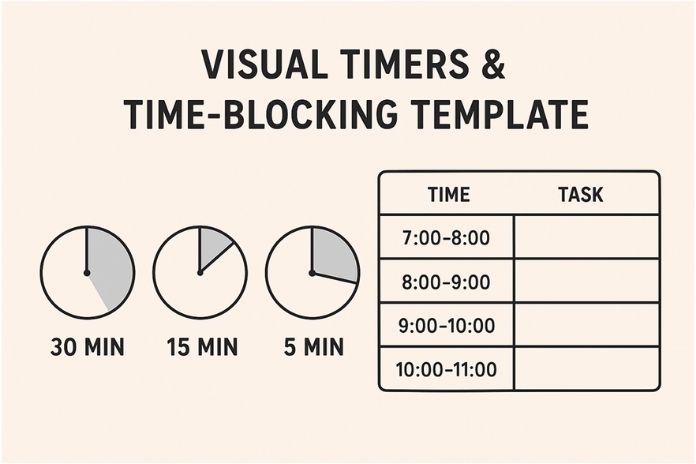 Time can feel like it slips away faster than anyone else’s. That’s not you, that’s ADHD. Let’s make time visible so you can work with it, not against it. Time blindness, or time agnosia, is one of ADHD’s most frustrating symptoms, the inability to sense time passing accurately.
Dr. Michael Manos, PhD, says time blindness isn’t a diagnosis or a specific symptom; it’s more just a general way of talking about the phenomenon of losing track of time. And it can be more extreme for some people.
“Everybody has time blindness at times,” Dr. Manos says. “We all can get caught up in something and get ‘in the zone.’ Some people with ADHD, though, are more prone to having difficulty being able to judge how long something will take to do or to lose track of time.”
People with ADHD are known for their deficits in attention. It’s right there in the name of the condition. But that’s only part of it.
Because time feels abstract, traditional schedules often fail. Instead, ADHD-friendly systems make time visible and tangible.
Try these methods:
- Visual timers: Use timers that show time disappearing. This makes progress concrete.
- Pomodoro technique: Work in 25-minute intervals with 5-minute breaks. Adjust durations to your focus span.
- Time blocking: Group related activities (emails, errands) into set time slots instead of reacting to everything in real-time.
- Add a 50% buffer: Whatever you think a task takes, multiply by 1.5. It offsets planning fallacy.
Visual cues transform invisible time into something measurable, and that’s the key. Time blindness isn’t poor planning; it’s a neurological difference that requires tangible compensations. Time management strategies work best when paired with systems that minimize distractions.
Managing Distractions and Maintaining Focus
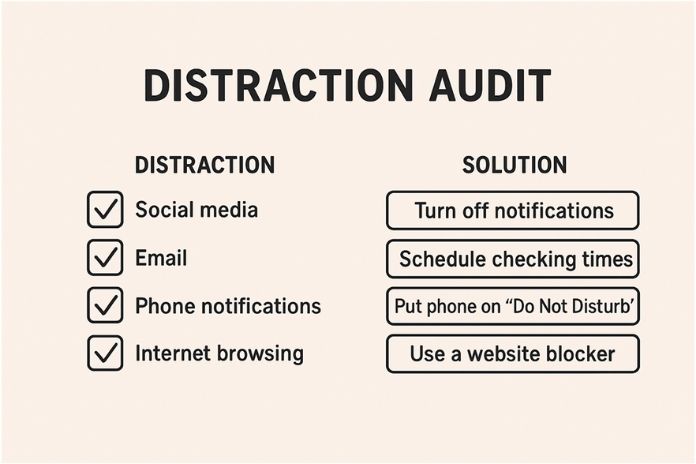 It’s not that you’re easily distracted; your brain is built to notice everything. The trick is designing your environment to work with your attention, not against it.
ADHD brains are wired for novelty and stimulation, which means distractions aren’t personal weaknesses; they’re environmental triggers. Research shows that cluttered or noisy environments can raise cortisol and worsen cognitive load.
You can design focus-friendly spaces:
- Reduce visual clutter: Keep your main workspace clean and clear.
- Use noise control tools: White noise, brown noise, or instrumental playlists help maintain steady stimulation without fragmentation.
- Silence your phone: Enable “Do Not Disturb” during focus sessions.
- Batch notifications: Check emails or messages at set times only.
The American Psychological Association (APA) states that brief mental blocks created by shifting between tasks can cost up to 40 % of someone’s productive time.
Think of this as environmental design, not willpower. Structure your space to support your brain’s wiring, not fight against it. While external changes help focus, managing internal emotions requires a different toolkit.
Read More: Top 5 Supplements for ADHD: Natural Support for Focus and Calm
Emotional Regulation and the ADHD Brain

Emotions in ADHD hit fast and hard, often leaving you surprised at your own reactions. The good news? You can train your responses to ride the waves instead of getting swept away.
Up to 70% of adults with ADHD experience emotional dysregulation, according to NIH research. Emotions rise fast and hit hard, but the intensity usually fades quickly if you don’t act impulsively in the heat of it.
Try these short, evidence-based tools:
- STOP technique: Stop, Take a breath, Observe, Proceed mindfully.
- Box breathing (4-4-4-4): Slows the heart rate and reactivates the parasympathetic system.
- Label emotions: Simply naming what you feel (“I’m anxious,” “I’m angry”) reduces limbic activation.
- Mindfulness training: Over time, it improves emotional regulation and impulse control.
Dr. Lidia Zylowska, M.D., discusses how mindfulness can re-route automatic and “unhelpful” reactions, and how basic mindfulness tenets can teach individuals with ADHD “when to be compassionate and accepting of ADHD symptoms, and knowing when to encourage changing an unhelpful pattern in thinking, feeling, or actions.”
Strong feelings aren’t flaws; they’re neurological responses that can be trained and managed.
References
- https://add.org/executive-function-disorder/
- https://www.additudemag.com/7-executive-function-deficits-linked-to-adhd/
- https://pubmed.ncbi.nlm.nih.gov/14658934/
- https://my.clevelandclinic.org/health/symptoms/23224-executive-dysfunction
- https://add.org/building-habits/
- https://psychcentral.com/adhd/9-tips-for-creating-a-routine-for-adults-with-adhd
- https://www.additudemag.com/how-to-stick-to-a-routine-adhd/
- https://www.pharecounselling.com/mental-health-blog/adhd-life-hacks-creating-a-daily-routine
- https://www.additudemag.com/how-to-get-organized-with-adhd/
- https://www.helpguide.org/mental-health/adhd/managing-adult-adhd
- https://add.org/adhd-coping-mechanisms/
- https://www.urmc.rochester.edu/MediaLibraries/URMCMedia/childrens-hospital/developmental-disabilities/ndbp-site/documents/73-ADHD-Friendly-Ways-to-Organize-Your-Life.pdf
- https://www.wondermind.com/article/adhd-organization/
- https://add.org/adhd-time-blindness/
- https://www.additudemag.com/time-management-skills-adhd-brain/
- https://www.ucihealth.org/blog/2024/05/time-blindness-and-adhd
- https://chadd.org/wp-content/uploads/2018/06/ATTN_10_15_BeatingTimeBlindness.pdf
- https://health.clevelandclinic.org/how-to-focus-with-adhd
- https://www.additudemag.com/manage-your-distractions/
- https://add.org/tips-for-focusing-with-adhd/
- https://www.helpguide.org/mental-health/adhd/managing-adult-adhd
- https://www.apa.org/monitor/2024/04/adhd-managing-emotion-dysregulation
- https://add.org/emotional-dysregulation-adhd/
- https://www.intechopen.com/online-first/1188913
In this Article