










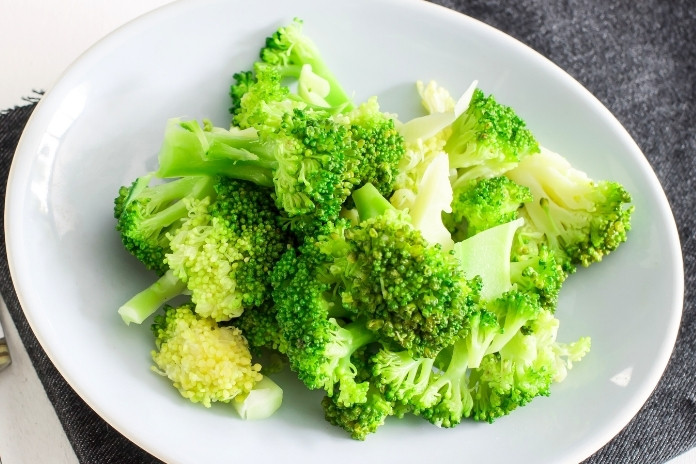
Broccoli has a reputation for being a genuinely nutrient-dense vegetable, and people tend to say it casually; in this case, it’s true. You get vitamin C, vitamin K, folate, fibre, potassium, and a group of plant compounds called glucosinolates that nutrition scientists talk about more.
Still, what looks good on a nutrition label doesn’t always hold up in a hot pan or on an oven tray. Heat, water exposure, and just the length of cooking can change more than people expect, which is why the “roasting vs steaming” question comes up so often.
Among everyday cooking methods, roasting and steaming come up most often for anyone trying to retain nutrients while still achieving better flavour and texture. Both are sensible choices and definitely gentler than boiling or deep-frying, but they never treat the vegetable the same.
What follows is a straightforward look at how each method influences some of broccoli’s key nutrients, and where one might have a slight edge over the other, based on the research we currently have.
Nutrients in Broccoli That Actually Change When Cooked
Some nutrients in broccoli barely change, no matter how you cook it, whereas others are very sensitive.
- Vitamin C – the most fragile nutrient in the vegetable. Heat and water break it down fast.
- Folate (B-vitamin) – also water-soluble and moderately sensitive.
- Vitamin K and carotenoids (plant pigment) – are more stable during cooking.
- Glucosinolates and sulforaphane precursors – these depend on both heat and an enzyme that starts breaking down once temperatures rise.
- Dietary fibre and minerals – stable under most cooking methods.
- Fiber remains stable whether raw or cooked.
The compounds most affected during cooking are vitamin C and glucosinolates. Several studies indicate that the degree of loss depends on temperature, duration, and whether the vegetable comes into contact with water.
For example, a controlled assessment published in the Journal of Zhejiang University Science B found that steaming preserved significantly more vitamin C and glucosinolates compared with boiling or stir-frying with oil.
A separate review in Food Chemistry reported that mechanical disruption and high heat can inactivate the enzyme myrosinase (which activates plant defense compounds), reducing the conversion of glucosinolates into sulforaphane.
Read More: Is Jasmine Rice Healthy? Nutrition, Benefits, and Healthier Ways to Eat It
Steaming: Nutrient Preservation and Considerations

How Steaming Works
Steaming exposes the vegetable to heated water vapour without submersion. The absence of direct water contact reduces nutrient diffusion. Heat is moderate compared with oven roasting or stir-frying, which typically protects heat-labile compounds.
Effect on Nutrients
Most research points to one simple fact: steaming retains more vitamin C, folate, and glucosinolates than any other cooking method. And a 2024 paper in Foods (MDPI) went a step further, noting that steaming also better preserves the compounds that eventually form sulforaphane than dry-heat methods.
Dietary fibre and minerals are largely unaffected.
Dr. Jenna Macciochi, an immunologist, has put it simply: steaming rather than boiling keeps more nutrients in your vegetables. She explains that if you cook anything at very high temperatures for too long, it may cause nutrient loss or even create compounds you really don’t want in your food.
Thus, steaming means minimal destruction.
Advantages
- Best protection of heat-sensitive nutrients
- No added fats, suitable for low-calorie or medical diets
- Texture remains firm if the cooking time is monitored
Limitations
Excessive steaming can still reduce vitamin C and degrade texture. The main practical drawback is palatability: steaming may produce a mild flavour profile, which some find less appealing.
Read More: Are Cotton Candy Grapes Healthy? Nutrition, Benefits, and Sugar Content
Roasting: Sensory Gains With Some Nutrient Loss
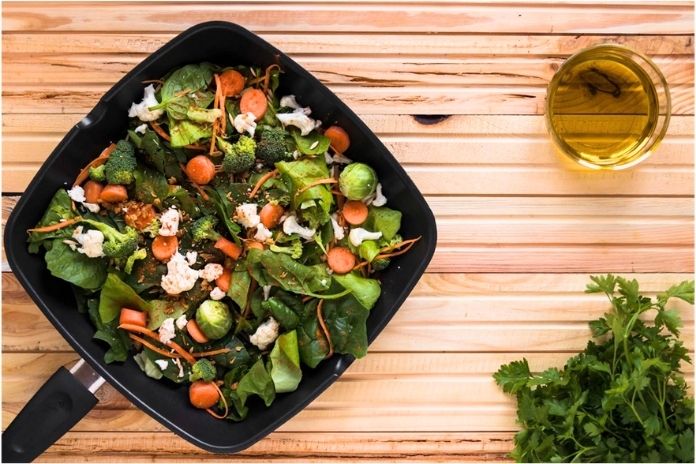
How Roasting Works
Roasting typically involves temperatures between 180 °C and 220 °C, often with added oil. Higher temperatures enhance flavour through non-enzymatic reactions such as the Maillard reaction (the browning reaction between sugars and amino acids in food) and caramelisation (a sugar-browning process).
Effect on Nutrients
Vitamin C degradation is significantly higher in roasted broccoli than in steamed broccoli. The previously referenced Zhejiang University study reported a substantial reduction when exposed to dry heat.
However, not all changes are negative. Some antioxidants, especially carotenoids and some phenolic compounds (act as antioxidants), become more bio-accessible (ready for absorption by the body) after roasting due to heat-driven cell wall softening.
A 2025 review in Applied Sciences reported increased carotenoid extractability from roasted cruciferous vegetables when oil was used sparingly. Dietary fibre remains intact, and the addition of olive oil may support the absorption of fat-soluble compounds.
Advantages
- Higher sensory acceptance due to texture and aroma
- Improved absorption of fat-soluble antioxidants when oil is present
- Useful for individuals who otherwise avoid vegetables
Limitations
- Noticeable loss of heat-labile vitamins
- Risk of nutrient damage if charred or overcooked
- Increased calorie density (calories per amount) due to oil
Comparison Summary
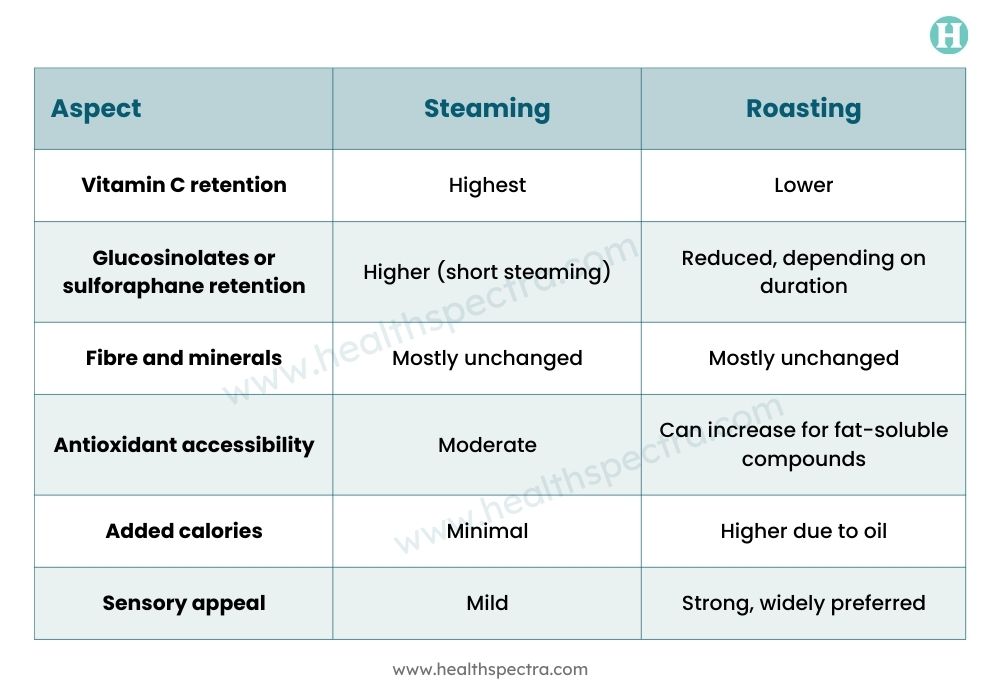
In terms of nutrient preservation, steaming is clearly superior. But roasting improves flavour and may increase vegetable intake (an outcome that is clinically relevant), especially in the long term.
Read More: Do You Absorb Nutrients Better on an Empty Stomach? Here’s What Experts Say
How to Preserve the Most Nutrients (Regardless of Method)
With broccoli, the solution may not be choosing one method permanently, but understanding how to optimize whichever method is preferred.
And this part surprises many people: according to clinical dietician Stephani Johnson, even the small steps before the cooking starts can change how much nutrition you finally absorb.
Focus on these habits:
- Steam for 4–7 minutes, but avoid over-softening.
- If roasting, keep the temperature below 200 °C and avoid dark charring.
- Cut florets evenly to prevent overheating of thinner tips.
- Adding a small amount of olive oil after steaming can balance nutrition and absorption.
You get maximum nutrition with maximum flavor.
Read More: Foods That Lose the Most Nutrients When Cooked (and How to Preserve Them)
How Much Broccoli Should Be Included in a Diet?
There is no precise number, but research gives us a helpful guideline. Eating broccoli a few times a week actually makes a real difference. For men, taking it about once or twice a week is linked with a lower risk of dying from any cause. For women, taking it three or more times a week gives the greatest benefit.
And you don’t need a large bowl either. One regular serving is roughly 75 grams, basically half a cup of cooked broccoli. It’s the type of portion you’d easily have in your dinner without really thinking about it.
The main idea is never to focus too much on grams, but to put broccoli on your plate regularly enough that it becomes a normal part of your routine, not just an occasional “health snack”.
Read More: Cold-Pressed vs. Centrifugal Juices – Which One Retains More Nutrients?
Conclusion
So, which is better, roasting vs steaming broccoli? For nutrients, Steaming is clearly the best. For flavor and habit-building, Roasting has the advantage. But the healthiest broccoli is the one you actually eat regularly.
So, if steaming bores you can roast it. And if roasting feels too high in calories, then steam it. Or mix both for a good balance. Broccoli is just a food; so, make it enjoyable and nourishing.
Key Takeaways
- If the goal is simply to retain most nutrients, then steaming is better than roasting. It is mainly because the heat is gentler and there’s no direct contact with water.
- Vitamin C in particular drops a little when broccoli is cooked on high heat for a long period, which is even common during roasting.
- Roasting isn’t “bad”; it just shifts the benefit. It improves flavour, is more enjoyable for many people, and when food tastes good, people tend to eat more of it consistently, which matters in the long run.
- Fibre and minerals don’t change much with either method, so the main nutritional “loss or gain” is more about heat-sensitive compounds.
- A balanced approach? Mix methods or steam, then roast.
FAQs
1. So which method is healthier overall?
Steaming edges ahead if we are talking purely about nutrient retention. But roasting may be better for someone who avoids vegetables unless they taste good.
2. Does roasting destroy all antioxidants?
Not completely. Sulforaphane gets reduced when exposed to long, intense heat, but a moderate roast under 200°C, and stopping once the edges brown keeps a good amount of it.
3. Is raw broccoli better than both?
Raw broccoli has more intact vitamin C and sulforaphane potential, but not everybody digests it comfortably. Light steaming often provides a good middle ground.
4. Does oil make roasted broccoli unhealthy?
Not necessarily. A small amount of olive oil isn’t harmful for most people and can help the body absorb fat-soluble nutrients. The issue is usually a portion, not the oil itself.
5. If I only want one rule to follow, what is it?
Avoid overcooking. Whether steaming or roasting, shorter cooking time protects more nutrients than the method alone.
References
- Baenas, Marhuenda, García-Viguera, Zafrilla, & Moreno. (2019). Influence of Cooking Methods on Glucosinolates and Isothiocyanates Content in Novel Cruciferous Foods. Foods, 8(7), 257.
- Eat for Health. (n.d.). Serve Sizes. Eatforhealth.gov.au; Australian Government.
- Jones, R. B., Frisina, C. L., Winkler, S., Imsic, M., & Tomkins, R. B. (2010). Cooking method significantly effects glucosinolate content and sulforaphane production in broccoli florets. Food Chemistry, 123(2), 237–242.
- Liu, X., Chang, Y., Li, Y., Zhang, X., Li, F., Song, J., Shi, H., Chen, X., & Cui, J. (2024). Prospective cohort study of broccoli consumption frequency and all-cause and cause-specific mortality risks. Frontiers in Nutrition, 10.
- Miškec, K., Frlin, M., & Šola, I. (2025). Impact of Different Thermal Processing Techniques on the Phytochemical Composition, Antioxidant Capacity, and DNA-Protective Properties of Broccoli. Applied Sciences, 15(13), 7469–7469.
- Yuan, G., Sun, B., Yuan, J., & Wang, Q. (2009). Effects of different cooking methods on health-promoting compounds of broccoli. Journal of Zhejiang University SCIENCE B, 10(8), 580–588.
In this Article