













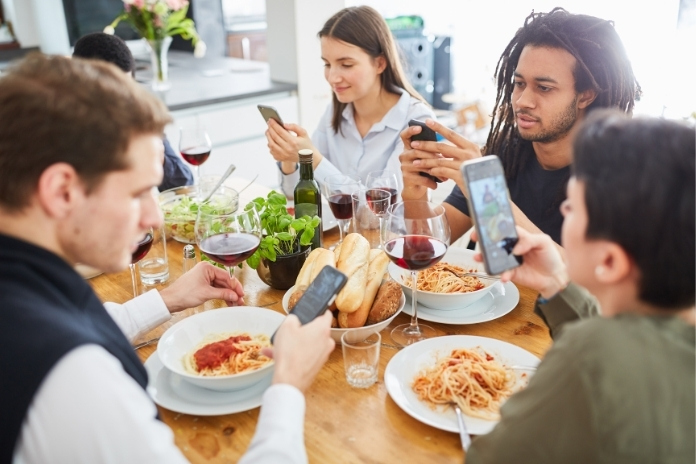
It’s almost second nature now: sit down to eat, unlock your phone, and scroll through Instagram, answer a few WhatsApp messages, or maybe catch up on a Netflix show. I used to think of it as harmless multitasking; after all, what’s wrong with pairing dinner with a little screen time? But over time, I noticed something had shifted. Meals weren’t meals anymore. They were background noise to whatever I was watching, reading, or replying to.
Food became less about taste and more about distraction. Sometimes I’d look down and realize I’d finished my plate without even remembering the flavors. Other times, I’d keep eating just because the episode wasn’t over, not because I was still hungry. That was my first hint that maybe the habit wasn’t as harmless as I thought.
When I started talking to friends about it, I realized I wasn’t alone. Some of them had already experimented with screen-free meals. Their stories surprised me: food tasted different, conversations felt richer, and even digestion seemed smoother. It made me curious, could something as simple as putting my phone aside really change how I eat, how I feel, and how I connect with others?
The answer, as it turns out, is yes. Eating without screens has ripple effects that touch everything from satiety and digestion to relationships and mental health. In this piece, I’ll walk through what my friends noticed when they unplugged during meals, what science says about mindful eating, and how I’m slowly learning to reclaim the simple act of just sitting down to eat.
Why We Eat With Screens

When I asked my friends why screens had become such a natural part of their meals, the answers felt instantly relatable. One laughed and said, “Dinner is my Netflix time; it feels incomplete without it.” Another admitted that lunch breaks at work often doubled as catch-up sessions for Slack and emails. Someone else confessed that scrolling Instagram over breakfast was the only “me time” she felt she had.
The truth is, screens at the table aren’t always a conscious choice. They’re a habit, one that sneaks in quietly until it feels automatic. Eating alone? The phone fills the silence. Eating with others? It’s easier to keep the TV running in the background or check messages between bites than to sit in stillness. In a way, screens have become the seasoning to our meals: we don’t always notice they’re there, but we’ve grown used to them.
But the convenience comes with a cost. A recent meta-analysis Watching Television While Eating Increases Food Intake (2025), confirms that eating while watching TV increases immediate and subsequent energy intake across many studies. The researchers pointed to a breakdown in “memory encoding”, basically, when our attention is split, our brain doesn’t fully register how much food we’ve already eaten.
That’s only part of the story. According to Harvard Health, screens also mess with the body’s natural satiety cues. When you’re distracted, you chew less, eat faster, and miss the subtle signals that tell you you’re full. The result? Overeating, bloating, indigestion, and a sense of heaviness that lingers long after the meal is over. And because the experience of eating wasn’t fully processed, you’re more likely to feel hungry again sooner than you should.
Screens may seem harmless at the table, but they reshape how we experience food at every level, sensory, emotional, and biological.
Read More: Digital Detox: 6 Steps to Healthy Screen Habits for the Entire Family
The Experiment: Going Screen-Free at Mealtimes

Two of my friends, let’s call them Rueben and Carel, decided to try a simple experiment: two weeks of meals without screens. The rules were straightforward: no phones, no laptops, no TV. Just them, their food, and whatever thoughts or conversations came up naturally.
For Rueben, who works long hours in IT, the adjustment was jarring at first. “I’m so used to checking work emails during lunch that the first two days felt uncomfortable, almost like I was wasting time,” he admitted.
Without the buffer of a glowing screen, he noticed the silence more. But something unexpected happened by the end of the first week: “I started tasting my food properly again. I realized I’d been eating the same dal and rice for months without really noticing it. Now, I could tell when the spices were different, or when the rice wasn’t as fluffy.”
Carel’s struggle was different. In her household, dinner with the TV on had always been the norm. “It felt like breaking a family ritual,” she said. The first few meals were almost awkward, quiet chewing, glances at one another, someone jokingly reaching for the remote. But over time, the silence gave way to conversation. “We started talking more about our day, and even small things like planning the weekend. By the second week, my parents actually said they preferred it this way.”
What struck both Rueben and Carel was how small the change was on paper, just turning off a screen, but how big it felt in practice. Rueben noticed he ate more slowly and finished feeling satisfied instead of stuffed. Carel realized she enjoyed her food more when her attention wasn’t split, and she felt closer to her family after meals. Both described a sense of presence they hadn’t felt at the table in years.
What They Noticed Right Away

The very first shift they both mentioned was pace. Meals slowed down. Without the constant pull of screens, there was no reason to rush, no notifications demanding attention. They chewed more thoroughly, noticed textures and flavors, and naturally stopped eating when they felt full rather than when the plate was empty.
Carel told me, “Food actually tasted different. I realized I’d been eating my mom’s cooking without really tasting it.” For her, flavors felt sharper, and the same dishes she’d grown up with somehow felt new again. Rueben noticed something different; his body responded. “Within a few days, I had less bloating after meals and no post-lunch crash at work,” he said, surprised that such a small shift in habit had such a clear physical payoff.
But it wasn’t only about the body. Emotionally, the change was harder at first. Without screens, meals felt quieter, sometimes too quiet. “At first it felt empty,” Rueben admitted. “I’d finish in silence and immediately want to grab my phone. But after a few days, the silence felt calming instead of awkward.” What started as discomfort slowly turned into something restorative.
Science supports what they experienced. Mindful eating, focusing on the act of eating rather than multitasking, has been shown to reduce overeating, ease digestion, and heighten appreciation of meals. Public health experts also highlight that when you eat with awareness, you tune in better to hunger and fullness cues, making it easier to stop before you’ve had too much.
Attention with a mindful attitude attenuates subjective appetitive reactions and food intake following food-cue exposure found that people who practiced mindful attention (focusing on cues/food) reported greater fullness after food cue exposure and ate less of snacks afterward than those who didn’t.
The Science Behind It

Curious about why Rueben and Carel felt such noticeable changes, I looked into the research, and it all made sense.
When it comes to satiety and overeating, studies show that paying attention to your food makes a huge difference. A 2014 review in Obesity Reviews found that mindful eating consistently reduced binge eating and helped people stick to healthier portion sizes. Screens, on the other hand, encourage “automatic eating”, finishing what’s in front of you without realizing how much you’ve had.
Digestion, too, responds to attention. Eating without distractions activates the parasympathetic nervous system, the body’s natural “rest and digest” mode. According to the NIH, this shift allows for better enzyme release, smoother nutrient absorption, and stronger gut function. When you’re multitasking, your body doesn’t prioritize digestion, which is why distracted meals often leave you bloated or sluggish.
There’s also a mental health angle. A 2020 study in Appetite reported that people who practiced mindful eating experienced less stress and more meal satisfaction than those who paired food with screens. In other words, eating without distraction doubles as a micro digital detox.
Associations between Watching TV during Family Meals and Dietary Intake Among Adolescents (Project EAT) found that adolescents whose families had meals without TV had higher intake of vegetables, dark green/yellow vegetables, and grains, and lower intake of soft drinks, compared to those whose families watched TV during meals.
Read More: Mindful Mornings: Breakfast Habits That Set You Up for a Stress-Free Day
Long-Term Effects After 2 Weeks

By the end of their two-week experiment, both Rueben and Carel noticed that the benefits weren’t just fleeting; they carried into their daily lives in meaningful ways:
- Better hunger awareness: Without a screen to distract them, both became more in tune with their bodies. They could distinguish between true hunger and “just eating because it’s mealtime” or boredom. This awareness led to smaller portions and less mindless snacking later in the day.
- Less bloating and smoother digestion: Meals slowed down naturally, which meant more thorough chewing and less rushing. Over time, that translated to reduced bloating and better overall digestion, a change Rueben found especially surprising.
- Emotional calm: What started as awkward silence shifted into a kind of daily ritual. Mealtimes became mini-breaks from constant notifications and stress, offering a pocket of calm in otherwise hectic routines.
- Improved relationships: For Carel, the change extended beyond herself. Her family, initially reluctant to ditch the TV, began talking more at dinner. “It wasn’t a big dramatic change,” she reflected, “but I noticed we were more connected.”
These experiences reflect what researchers at Harvard Medical School have observed: shared meals without digital devices foster stronger communication, deeper bonding, and even better emotional well-being for children and adults alike. What began as a small experiment turned into a reset, not just for their bodies, but for how they connected with themselves and others.
Challenges They Faced
Of course, it wasn’t all smooth sailing. The transition away from screens came with its own hurdles, and both Rueben and Carel admitted it wasn’t easy at first.
- Restlessness and withdrawal: Rueben described the first few meals as almost unbearable. “I had this urge to check notifications mid-meal. It was like an itch I couldn’t scratch, almost like withdrawal,” he said. The habit of constant connectivity made silence feel uncomfortable, and the pause between bites seemed longer without the usual scroll.
- Social pressure: Carel found the hardest part wasn’t at home but in social settings. “When we went out to dinner with friends, everyone else was on their phones. I felt awkward being the only one not scrolling.” She admitted it sometimes made her feel left out, even though she was more present at the table.
- Breaking ingrained habits: Both realized how deeply screens had become tied to eating, a ritual they hadn’t questioned until now. Replacing that background noise with mindful awareness felt strange, even unsettling, in the beginning.
Research shows that many people do feel anxiety when separated from their phones; the condition, often referred to as nomophobia, has been linked in studies to heightened anxiety levels, especially when access to the phone is disrupted.
The encouraging part? Both friends agreed the discomfort didn’t last forever. By week two, the restlessness had softened. Checking the phone no longer felt urgent, and the awkwardness in social settings began to shift into quiet confidence.
How to Make Screen-Free Meals Work for You

Breaking the habit of eating with screens isn’t about rigid rules; it’s about making small, sustainable changes that shift your attention back to the meal in front of you. Based on what Rueben and Carel learned, and what experts suggest, here are some ways to make it easier:
- Start small: Don’t pressure yourself to overhaul every meal right away. Begin with the one that feels simplest, like breakfast or your mid-day snack. Small wins build momentum.
- Create cues: Set yourself up for success by making screens less accessible. Put your phone in another room, switch it to “Do Not Disturb,” or keep it face down and out of reach. Visual cues matter.
- Replace, don’t just remove: Silence can feel awkward if you’re used to background noise. Instead of trying to power through, replace screens with mindful practices, pay attention to flavors, textures, and aromas. Or, if you’re with family or friends, use the time to ask a question and start a conversation.
- Make it a ritual: Turning screen-free meals into a ritual helps with consistency. Light a candle at dinner, play soft music, or make it a point to share one highlight of the day with whoever’s at the table. These small anchors shift the focus from screens to presence.
- Set expectations with kids (and adults): Habits are contagious. If you want screen-free meals at home, make it a family expectation. Over time, kids (and adults) begin to see meals less as multitasking moments and more as shared pauses in the day.
The beauty of these strategies is that they’re flexible. You don’t need to be perfect; even a single screen-free meal each day can make a noticeable difference in digestion, satiety, and connection.
“When families and individuals eat without screens, the benefits go well beyond nutrition. Research shows that shared, screen-free meals are linked with lower stress, healthier eating habits, and better communication between family members. From a medical perspective, being fully present with food also improves chewing and digestion, because the body shifts into ‘rest and digest’ mode when it isn’t distracted by devices.” – Dr. Anne Fishel, PhD, Co-founder of The Family Dinner Project & Associate Clinical Professor of Psychology, Harvard Medical School
Read More: Mindful Eating – Learn About The Tips, Strategies And Benefits
My Turn: Trying It for Myself
After hearing Rueben and Carel’s stories, I knew I couldn’t just write about this; I had actually to test it out. So I made a simple rule for myself: no screens at meals.
I’ll be honest, it feels awkward at first. Breakfast has always gone hand in hand with scrolling through the news, and lunch usually comes with a quick dive into messages. Dinner, more often than not, feels “incomplete” without a show or a YouTube video playing in the background. Taking that away felt like pulling a rug from under my routine.
But here’s the thing: on the few occasions I’ve managed to stick to it, I’ve noticed a shift. Food tastes sharper, almost louder, when I’m paying attention. I chew more slowly. I notice textures I used to ignore. Even the silence has a weight to it, sometimes uncomfortable, sometimes strangely calming. It feels less like I’m just “fueling up” and more like I’m actually experiencing my meal.
There’s also this unexpected ripple effect: without my phone, meals stretch out a little longer. I don’t rush. My brain gets a short break from constant updates. It’s like reclaiming a pocket of time that had been swallowed up by habit.
I won’t pretend it’s easy. The urge to reach for a screen is still there, especially when I’m eating alone. But that’s why I’m treating this like a two-week experiment, to see if persistence can turn this challenge into a habit.
So here’s my little note to myself: stay patient, stay curious, and give this experiment an honest shot. Who knows? Maybe this tiny change becomes the start of something bigger.
Conclusion
Going screen-free during meals might sound like a small experiment, but the results are anything but small. From my friends’ stories and the research that backs them, the shift goes beyond just eating without distraction. People report better digestion, less bloating, and improved satiety, but also something deeper: calmer moods, stronger family connections, and even a renewed appreciation for the food on their plate.
That doesn’t mean it’s effortless. Screens are designed to hook us, and the urge to scroll while chewing can feel almost automatic. The discomfort in those first few meals is real. But here’s what stands out: even one screen-free meal a day creates momentum. It slows you down, helps you notice flavors, and reminds you that food is not just fuel, it’s an experience.
So if you, like me, are used to pairing dinner with Instagram, news feeds, or Netflix, here’s a challenge worth trying: give yourself a week. Put the phone in another room. Close the laptop. Let your plate and the people around you hold your attention. At worst, you’ll discover silence that feels unusual. At best, you’ll find a habit that changes not just your health, but your headspace too.
Because in the end, mindful eating isn’t about perfection. It’s about reclaiming something that’s been quietly taken from us, presence.
References
- https://pmc.ncbi.nlm.nih.gov/articles/PMC8671257/
- https://www.sciencedirect.com/science/article/abs/pii/S0195666322000198
- https://sumonsleeve.com/2021/03/why-i-started-using-screens-at-mealtime-6-minute-read.html
- https://www.srnutrition.co.uk/2023/08/can-my-child-have-screen-time-at-meals/
- https://flintoclassplayschools.com/blog/parenting/mobile-phones-eating
- https://famedico.com/is-it-good-to-use-mobile-phones-or-tv-while-eating/
- https://www.uoc.edu/en/news/2024/eating-in-front-of-screens-can-lead-to-compulsive-consumption-of-ultra-processed-foods
- https://appetitetoplay.com/healthy-eating/tips-ideas/screens-and-eating
- https://www.bbc.com/future/article/20240730-is-eating-in-front-of-the-tv-really-that-bad-for-you
- https://eattypelive.com/2025/03/11/screen-free-eating-step-by-step/
- https://www.bespokefamily.co.uk/blog/screentime-and-mealtimes-is-it-ok
- https://www.reddit.com/r/ScienceBasedParenting/comments/zaqsvs/screen_time_while_eating/
- https://www.mayoclinichealthsystem.org/hometown-health/featured-topic/5-ways-slimming-screen-time-is-good-for-your-health
- https://www.vice.com/en/article/why-we-cant-stop-looking-at-our-screens-when-we-eat/
- https://www.bedihospital.com/blog_Screen-Time-&-Food-should-not-go-together.php
- https://www.sciencedirect.com/science/article/abs/pii/S0195666321005778
- https://www.mdpi.com/2072-6643/17/8/1311
In this Article