















Although many individuals think that crunches put undue strain on their neck and lower back, they have long been the go-to exercise for firmer abs. Back discomfort is a common occurrence for millions of Americans.
As bone density decreases, muscles become more rigid, and discs start to lose their fluid and flexibility; this issue gets worse with age. Being overweight and mostly sedentary increases your chance of back problems.
Many individuals are surprised to learn that having a strong core promotes improved posture, balance, and stability, in addition to enhancing their overall shape.
Because the core bridges the top and bottom halves of the body, strengthening it helps reduce strain in everyday movements, such as standing upright, grabbing objects overhead, and leaning down to tie footwear. Particularly as we age, strengthening these muscles might help reduce the risk of falls and accidents.
This manual presents safe core training techniques that can help you maintain pain-free exercises, improve performance, and balance your body.
Read More: Sit-Up Variations for Weight Loss: Maximize Fat Burn with Core Workouts
Why Crunches Aren’t for Everyone
Despite their apparent simplicity, crunches may put a lot of strain on the neck and lumbar spine. Crunches and their several variants are mainstays of core training regimens and the fitness world.
“Flexibility intolerant low back pain” is one of the most prevalent forms of low back pain. It implies that someone’s low back discomfort will worsen if their low back is flexed or rounded. Practicing crunches continuously flexes our lower back. We are doing the same action over and over again, which frequently exacerbates people’s low back discomfort.
Crunches don’t engage your core muscles to a great extent. Even while performing 70 repetitions of a strenuous round of 100 crunches may seem like a lot of effort, you are really only using one muscle group, the rectus abdominis (rectus). The body’s actual “core” is made up of many additional muscles.
Crunches may be more detrimental to some populations than beneficial. Traditional crunches frequently exacerbate the problems of those with postural abnormalities, ruptured discs, or persistent back discomfort.
Even those who lead sedentary lives may lack the core stability required to maintain the movement safely. It’s better to look at crunch substitutes that build the abdominal wall without putting undue strain on the spine rather than forcing through discomfort.
Back-Friendly Core Exercises (Crunch-Free)
1. Plank

While maintaining a neutral spine, a plank develops your whole core.
Steps:
- Bend your arms so that your forearms rest on the floor after starting in the push-up posture.
- Keep your body, hips, and legs aligned in one straight line.
- To stabilize, contract your gluteal and abdominal muscles.
- To prevent the lower back from sagging, draw your core in around the belly button.
- For as long as you can, maintain the posture while breathing deliberately.
- While maintaining a neutral spine, a plank develops your whole core.
2. Bird Dog
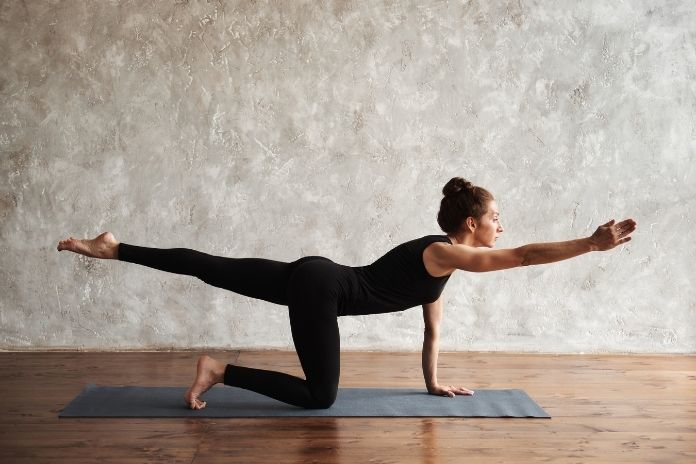
A functional but straightforward method to improve balance, while activating nearly all of your core stabilizers.
Steps:
- Get on all fours with your hands placed just behind your shoulders and your knees aligned under your hips, keeping your spine neutral.
- Engage your core to minimize movement of your torso.
- At the same time, stretch your right arm out in front and your left leg back.
- Hold the position and balance for a single, steady breath.
- Slowly return to the initial position, and then switch to the opposite arm and leg.
Read More: How to Protect Your Knees During Workouts: Tips Every Active Person Should Know
3. Mad Cat
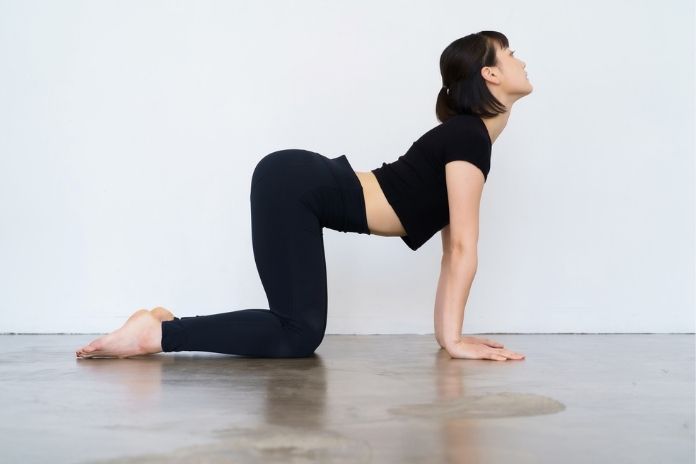
This exercise stretches and strengthens the core while gently moving the spine.
Steps:
- Start on your hands and knees, placing your knees behind your hips and your wrists beneath your shoulders.
- As you curve your back upward, see a cord tugging your belly button toward the ceiling.
- Initiate an “angry cat” arch by bringing your chin in slightly.
- As you fully inhale, maintain a rounded position.
- To come back, allow your chest to drop closer to the floor, tighten your abs, and pull your head back slightly.
- Breathe naturally as you consistently and gently repeat the motion.
4. Bridge
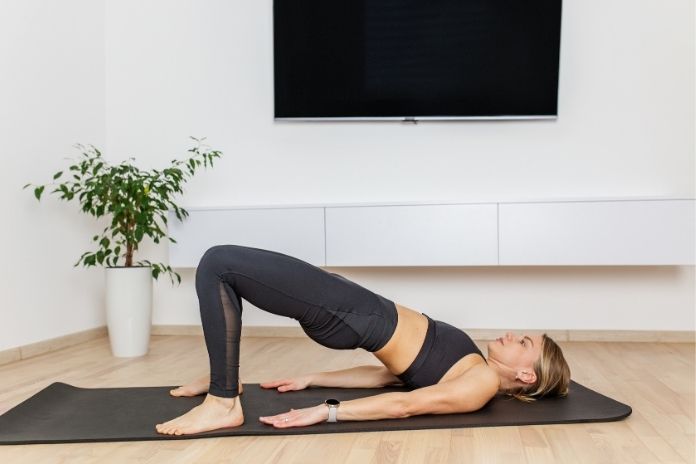
An exercise that helps you support your spine while strengthening your core and glutes.
Steps:
- Start lying on your back with your feet flat on the floor and your knees bent at 90 degrees.
- Use your deep core muscles to raise your hips into the bridge position.
- Keep your lower back in a natural curve; do not create excessive arching.
- Once you are stable, lift your left foot from the ground to hip height.
- Place the left foot on the floor, then perform the same motion with the right leg.
Benefits of Crunch-Free Core Training
Regardless of how you exercise or where you are in your fitness journey, having a strong core has advantages before, during, and after your exercises. You may enhance your athletic performance, prevent injuries, improve your workout technique, balance your body, and increase your everyday agility by strengthening your stomach.
Supports proper form: It can be challenging to maintain an appropriate form during some workouts if you don’t have sufficient core strength. Additionally, you run a higher risk of damage if you overcompensate for core weakness by putting excessive weight or strain on other bodily areas, such as your spine. Therefore, include time for core strengthening exercises in your fitness routine to ensure that your workouts feel good (and stay safe).
Enhances Muscular Efficiency and Control: In addition to preventing injuries, using good form makes motions easier to execute and more efficient. “Having a strong core definitely helps with cycling, especially when you come out of the saddle,” says Peloton instructor Emma Lovewell.
Enhances Stability and Balance: Think of your core as the bridge linking your upper and lower body. Strengthening these muscles enhances stability and balance during activities like jogging or maintaining a yoga posture.
Enhances Performance: Increasing your core strength may significantly improve your workouts and, in some situations, bring you one step closer to breaking personal records. According to a 2023 research in Behavioral Sciences, core training may significantly impact an athlete’s overall performance, including their balance and core endurance.
Reduces Back Pain: If you suffer from low back pain, the solution can be in your very own hands. Strengthening your core has several advantages, including reducing back discomfort. “Your core is not just the front of your body, but it also includes your lower back,” notes Emma.
Read More: Targeting Abs: Daily Exercises for Core Strengthening
Tips for Safe Core Training with Back Pain

- Preserve the natural curvature of your back throughout every movement. Avoid excessive arching/rounding; this posture will relieve the stress on your joints and discs.
- Quality over quantity. Smooth, deliberate movements avoid strain and recruit stabilizing muscles more effectively.
- Rapid twists or snaps may aggravate sensitive tissues. Change or eliminate any position that causes discomfort.
- Discomfort means you need to rest or modify your position. You should never “work through” pain.
- A physical therapist may be necessary to create a personalized, safe abdominal training program for individuals with chronic issues and ensure that exercises for back pain are suitable.
Read More: The 3D Core Workout – Why You Need More Than Just Crunches
Conclusion
Although crunches are the most well-known ab exercise, there are many more ways to develop a firm abdomen. Many people get sore rather than stronger as a result of repetitive spinal flexion, which can strain the neck and lower back. By switching to crunch-free core exercise, you may enhance posture, activate deeper stabilizing muscles, and lower your chance of pain or injury.
Now is the moment to reconsider your strategy if you have been depending on crunches. Safe spine exercises that train smarter, not harder, should take the place of repeated flexion. Feel the difference—more substantial, more steady, and pain-free—after attempting a few of the exercises listed above.
References
- https://www.health.harvard.edu/staying-healthy/want-a-stronger-core-skip-the-sit-ups
- https://www.mayoclinic.org/healthy-lifestyle/fitness/in-depth/core-strength/art-20546851
- https://www.kaizo-health.com/best-core-exercises-that-wont-harm-your-back/
- https://theeverygirl.com/crunches-bad-for-you/
- https://www.womensrunning.com/training/cross-training/why-you-dont-need-to-waste-your-time-with-crunches/
- https://liachiro.com/this-is-why-you-shouldnt-do-crunches-and-what-you-should-do-instead/
- https://backinshapeprogram.com/2024/02/5-core-strengthening-exercises-to-fix-your-low-back-pain-for-good/
- https://www.today.com/health/diet-fitness/home-ab-workouts-rcna206868
- https://pmc.ncbi.nlm.nih.gov/articles/PMC9952339/
- https://www.onepeloton.com/instructors/islandlife17
In this Article