















- Heavy 10-yard sled pushes maximize mechanical tension, the key driver of muscle growth.
- Short distances reduce fatigue, allowing consistent high-intensity effort across sets.
- Progressive overload (load, volume, intensity) is essential for continuous hypertrophy gains.
Sled pushes are sometimes called conditioning exercises, but that’s not the whole story. They can be an effective sled push for hypertrophy and general muscular growth when properly planned.
Manipulating load, distance, and effort is crucial, particularly when performing quick, high-intensity exercises like the 10-yard push. By using this method, you can maintain the ideal resistance intensity without becoming overly fatigued, maximize mechanical tension, and extend the time under tension.
This article discusses the theory underlying concentric-only movement patterns and their role in hypertrophy, as well as how sled training for muscle growth truly works. Additionally, you will learn how to perform resistance training without weights, create an organized sled push workout for size, and apply efficient sled-loading strategies.
Read More: Hypertrophy Training vs Strength Training: Key Differences, Benefits, and Which One You Need
Can Sled Pushes Actually Build Muscle?
The sled is one piece of gym equipment that has gone from being the least used to one of the most sought-after items on the floor. You can use sleds for more than just pushing and pulling because of their versatility.
Unlike many heavy compound exercises, the sled push doesn’t need you to lift hundreds of pounds on your back. Rather, you drive the weight with your legs as the primary driver while angling your body diagonally.
Improving acceleration, particularly in the early stages of a sprint, is one of the main advantages of sled training. It is accomplished by putting athletes in a position known as “acceleration lean,” in which their body’s angle coincides with the sled’s resistance, compelling them to use more muscle fibers.
Sled pushes eliminate eccentric loading, which reduces joint stress and muscle damage compared to traditional lifts. They do, however, enable you to produce great resistance intensity, particularly when pushing large loads. Because of this, when properly planned, sled training for muscle growth is not only feasible but also quite effective.
“Training to produce power is as important for overall strength and muscle size development as it is for an athlete’s performance development,” says Jordan Brown, a performance specialist at EXOS in San Diego.
Why the 10-Yard Distance Is Effective for Hypertrophy
The 10-yard push is deliberate rather than haphazard. You can continue to produce at a high level over short distances without becoming overly tired.
Short Bursts Maximize Stress: Your muscles are constantly under stress when you push heavy loads more than ten yards. The primary trigger for hypertrophy, mechanical tension, is maximized in this way.
Better Output, Less Fatigue: Extended sled pushes often turn into endurance exercises. Short distances allow for repeated high-quality efforts, which are crucial for sled push sets and reps aimed at muscle growth, while maintaining the focus on strength and power.
Activation of Fast-Twitch Muscle Fibers: Fast-twitch muscle fibers, which have the greatest developmental potential, are recruited during brief, powerful efforts. For this reason, the benefits of the heavy sled push include increased strength and size.
Repeatable Effort: You can perform several sets of 10-yard pushes at a consistent intensity, facilitating the gradual application of progressive overload.
Key Drivers of Muscle Growth in Sled Training

Sled training helps muscles grow (hypertrophy) by placing significant mechanical and metabolic stress on them through long, hard, and often concentric-focused efforts.
High Mechanical Tension: Your muscles, especially your back and hamstrings when you pull, and your quadriceps, glutes, and calves when you push, get a lot of stress when you pull or push heavy weights.
Metabolic Stress (Hypertrophy): Doing sets with short or long breaks (45–90 seconds) quickly builds up a lot of metabolic waste, which is a major driver of muscle growth.
Concentric-Focused Movement: Sled training is a great way to build muscle with less pain because it doesn’t put too much stress on the muscles during eccentric contractions (like squats do). It means you can train more often and recover faster while keeping the muscles under constant tension.
Duration Under Strain: Sled pushes are short, but controlled movement extends the duration under strain, especially when pushing heavy loads slowly.
Effort and Getting Close to Tired: Finishing sets close to failure helps muscles grow. Your resistance level needs to be high enough to test your muscles, no matter how heavy or light the load is.
Read More: Best 4-Day Workout Split: How to Train for Muscle, Strength, and Recovery
Sled Loading Strategies for Muscle Hypertrophy
Heavy Load (Strength-Focused Hypertrophy)
The best way to maximize mechanical tension is this:
- Load: Extremely heavy (hard to move)
- Ten yards is the distance
- Effort: Almost at maximum
- Take two to three minutes to rest
Moderate Load (Balanced Hypertrophy Stimulus)
This method finds a happy medium between volume and tension:
- A moderate load
- Speed: Controlled
- Sets: Louder
- Take a break for at least 60 to 90 seconds
It is perfect for sled push sets and reps that work on both mechanical tension and metabolic stress.
Light-to-Moderate Load (Metabolic Stress Focus)
This method makes you more tired and gives your muscles a pump:
- Load: Light to moderate
- Speed: Faster thrusts
- Take a break for 30 to 60 seconds
This approach enhances time under tension and metabolic stress, making it a useful addition to hypertrophy training methods and sled programs.
How to Structure a 10-Yard Sled Push Workout
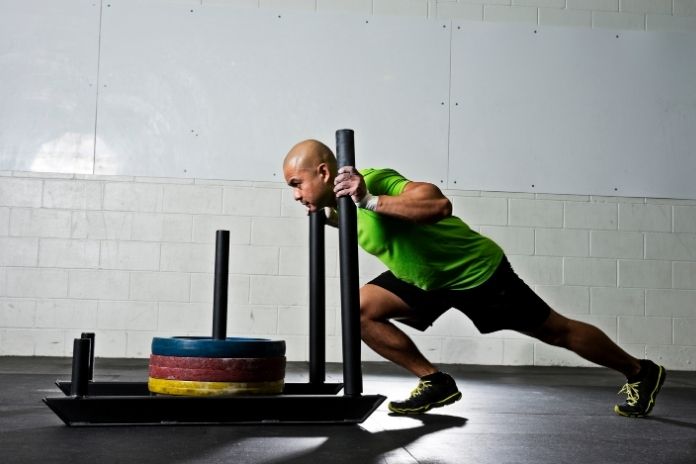
A well-designed sled push workout for size should include proper volume, intensity, and progression.
Reps, Sets, and Rest:
- 6–10 pushes in a session
- Each push is 10 yards
- Depending on the load, two to four rounds in total
- Depending on the intensity, rest for 60 to 180 seconds
Strength Hypertrophy on a Heavy Day:
- 8 × 10-yard pushes (heavy load)
- Take two to three minutes to rest
Day of Moderation (Balanced Growth):
- 10 × 10-yard pushes
- 60 to 90 seconds of rest
Day of Metabolism (Pump Focus):
- Push 12 × 10 yards
- 30 to 60 seconds of rest
For long-term muscular growth, this structure guarantees appropriate progressive overload.
Weekly Frequency:
- Two to three sessions every week
- For optimal effects, combine with conventional lifting
Sled pushes also work well as resistance training without weights, making them ideal for minimal-equipment setups.
Read More: Toning Workouts for Men vs Women: What’s the Difference?
Which Muscles Benefit Most From Sled Hypertrophy Training
A dynamic exercise, the sled push mostly works the lower body, particularly the calves, quadriceps, and glutes.
Glutes: Because they are required to offer support while extending your knees and hips (stability), the glutes bear a significant portion of the movement. Additionally, the primary muscle used for a strong leg extension, particularly at the hip joint, is the gluteus maximus.
Quadriceps: During each sled push step, the quadriceps are naturally active because they expand the knee joint. Your quadriceps become extremely tense when you push the sled because your knees flex as you step forward and stretch as you drive off the leg.
Calves: When performed with big loads, the sled push can be a calf builder. The sled push enables you to produce large levels of force through the calf with each step, especially under big loads, even if there isn’t much eccentric loading—a crucial component of muscular building.
Because your footing is crucial during the sled push, the muscle is nearly always under strain, which prolongs the time under tension.
Upper Body Involvement: Pushing mechanics involve the shoulders, arms, and chest, particularly when using different hand positions.
Common Mistakes That Limit Muscle Growth With Sleds
Sled training is a good way to build muscle, but mistakes can worsen the results.
Using Too-Light Loads: Light loads stop hypertrophy by lowering mechanical strain.
Treating Sled Pushes as Cardio Only: People often think of sled pushes as only cardio. If the resistance isn’t strong enough, you won’t help your muscles grow.
Bad Posture: If your body is at the wrong angle, you are more likely to get hurt, and your muscles won’t work as hard.
Not Enough Progressive Overload: If you don’t gradually increase load, volume, or intensity, progress stops.
Read More: At-Home Strength Exercises Without Equipment: That Actually Work
Who Can Benefit Most From This Approach

The sled push should be a part of every program, whether your goal is to complete a 500-pound back squat, run a half-marathon, or rehabilitate from an injury.
Beginners: Sled pushes are excellent for people who are new to resistance training without weights because they are easy and efficient.
Strength and Power Athletes: The sled push can enhance leg strength, speed, and muscle growth. One advantage of the sled push is that it frequently doesn’t interfere with major strength-building exercises like deadlifts and squats.
It can also help increase the blood flow, reduce lower back stress, and enable you to use the lower body more frequently without overstressing it.
Endurance Athletes: Although for different reasons, endurance athletes, such as marathon runners, stand to gain in the same ways as strength athletes. Running regularly may be really stressful on the knees, particularly if you’re usually pounding hard ground and pavement.
Therefore, without knee stress, the sled push may aid in enhancing a runner’s training and endurance. Of course, a runner must run, but adding a few miles of low-impact, low-weight sled work provides a different kind of stimulation.
Safety Considerations for High-Load Sled Training
Safety should always come first, even when heavy sled pushes have many advantages.
Control Fatigue: End sets before your form deteriorates. Fatigue can increase the risk of injury and reduce the intensity of resistance training.
Maintain Good Posture: Keep your core active and your spine neutral.
Progress Gradually: To prevent overuse injuries, gradually increase the load or volume.
Know When to Scale Back: Lower the intensity or frequency if you feel pain or extreme exhaustion.
Read More: Genetic Testing for Hypertrophic Cardiomyopathy: Should Your Family Get Screened?
Conclusion
Sled training shows that you don’t always need to lift weights to build muscle. When you perform short-distance pushes correctly, they create high tension and steady effort, both of which drive hypertrophy. By focusing on the right amount of weight, controlled execution, and increasing overload, you can turn a simple tool into an effective way to build muscle.
The 10-yard approach is different because it lets you do high-quality pushes repeatedly without getting too tired. Including sled push for hypertrophy in your regimen can improve lower-body growth and lessen joint stress, regardless of your level of experience.
References
- Mike Dewar. (June 28th, 2024). The Sled Push May Be the Ultimate Leg-Builder (Yes, We’re Serious).
- Holder, B. Utilizing a sled training spectrum for athlete development.
- Simone, A. J. (2020, February 8). 10 reasons to start using the sled/prowler in your training
- Alec Enkiri. (14 December, 2020). Why you should be doing heavy sled drags
- Foundry. (April 5, 2023). The Science Behind Prowler Sled Training: How It Works and Why It’s Effective.
- Amy Roberts, C.P.T. The Beginner’s Guide to Sled Training for More Power
In this Article