
Clean beauty sounds wholesome, safe, and eco-friendly. Here’s the truth most people never hear: there is no standard definition. The term ‘clean beauty’ is not defined or regulated by any official body. Every brand decides for itself what “clean” means.
It means avoiding ingredients that are highly controversial, such as parabens, phthalates, sulfates, mineral oil, and synthetic fragrances. The focus is on transparency, sustainable sourcing, recyclable packaging, and simpler formulas. It appeals to people who prefer gentle and minimalist skincare.
But here’s the thing: clean beauty is not the same as dermatologist-tested skincare. It also does not guarantee results. A formula can be clean and still not have the potency of science-backed skincare.
You must remember that “natural” does not always mean “better.” Even extracts from botanicals could irritate sensitive skin. Conversely, many synthetic ingredients are safer, more stable, and even more predictable than their natural alternatives. For this reason, the natural vs synthetic skincare argument is much deeper than you think.
While clean beauty can be great, it is not always the most dermatologist-tested skincare option.
What Does “Clinical Beauty” Mean?
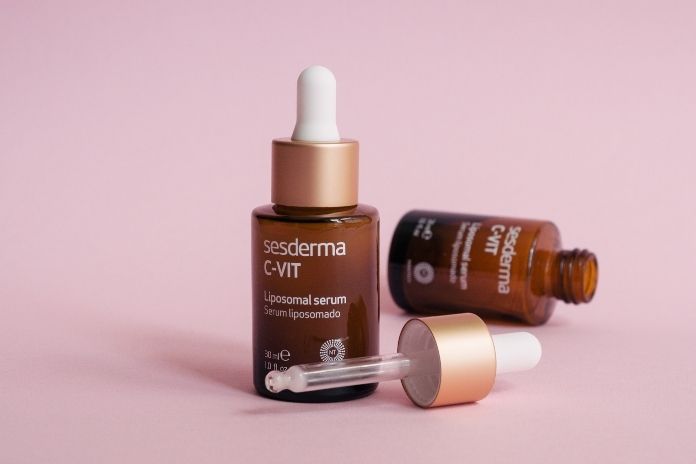
Clinical beauty is about performance. These formulas undergo dermatological testing, clinical trials, or consumer studies. This is the reason they end up in the science-backed skincare category.
These products typically feature actives with proven benefits, such as retinoids for wrinkles, niacinamide for redness, peptides for firming, and ceramides for the skin barrier. We usually trust these ingredients because scientific studies consistently show their effectiveness.
Clinical beauty also means:
- Clear, measurable results
- Higher-quality, stable formulations
- Correct concentrations of actives
- Often, they are recommended by dermatologists
If you have to choose between clean beauty vs. clinical skincare, remember that clinical beauty is not “chemical-heavy” or harsh. It simply means there’s evidence behind the claims. Many clinical brands combine natural and synthetic ingredients because they prioritize efficacy over ideology.
Clinical beauty may be enhanced with evidence-based skincare products. The products target acne, aging, dark spots, or improve skin texture.
Read More: Best Hyaluronic Acid Moisturizers: Hydrate and Plump Your Skin for a Youthful Glow
Clean vs. Clinical — Breaking Down the Key Differences
Let’s compare them in the clearest way possible: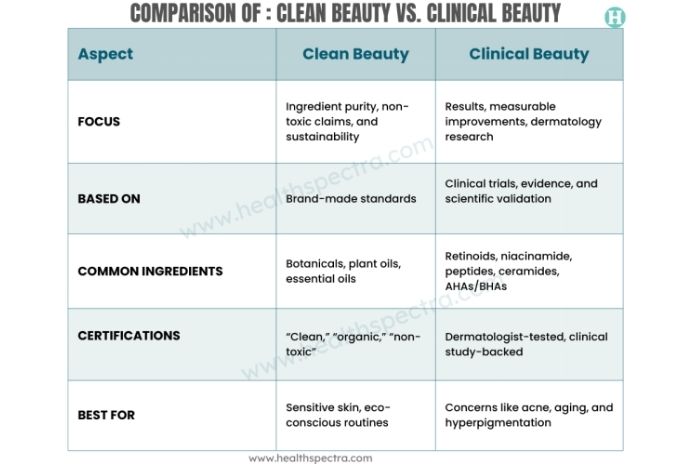 The smartest choice? You don’t have to pick a side. You can opt for a hybrid routine – a clean moisturizer paired with clinical serums that contain clinically proven skincare ingredients.
This way, clean beauty offers gentleness and transparency, while clinical beauty delivers results.
How to Spot Science-Backed Skincare Products
Here are a few tips that’ll help you choose and spot science-backed skincare:
1. Read the Ingredient List
This is the most powerful habit you could ever create.
You must look for active ingredients that you can actually identify. Try to identify ingredients like retinoids, vitamin C, niacinamide, ceramides, peptides, and salicylic acid. These appear frequently in science-backed skincare research.
A few quick rules:
- Ingredients are listed in order of decreasing concentration.
- If the “hero” ingredient is the last one on the list, it is present in a negligible amount. However, this may be the ingredient you’re basically being marketed to.
Understanding this helps you cut through both clean beauty myths and misleading claims of clinical-sounding brands. To understand the natural vs. synthetic skincare debate, you must judge ingredients based on performance, not labels.
2. Check for Evidence or References
A serious clinical brand is not afraid to show its data. You may look for:
- Before-and-after results and genuine reviews from customers.
- Clinical trial percentages, which are disclosed on the brand’s page.
- References to published studies that substantiate the claims.
- Clear, specific claims, and avoid falling prey to marketing gimmicks.
Watch out for generalized phrases such as “Clinically inspired”, “Lab formulated”, or “Dermatologist recommended”.
If you are looking for evidence-based skincare products, opt for brands that prove their claims with actual numbers and are not just marketing traps.
Kelly Dobos, a cosmetic chemist, encourages consumers to look for brands that share “quantitative data from instrumental measurements,” like a potential change in wrinkle depth. “Are there any clinical studies that the manufacturer is providing that look beyond the claims that are just ‘visible difference’?” Dobos asks.
3. Look for Transparency and Certifications
Certifications can help you see whether a product leans clean or clinical:
- Clean Certifications:Look for clean beauty certifications such as EWG Verified, Credo Clean, and Sephora Clean.
- Clinical Certifications: Clinical certifications include terms such as dermatologist-tested, research-backed, and FDA/EU-compliant.
Clean and clinical certifications are not proof enough. However, they help you quickly categorize the products. Once you know how to read skincare labels, spotting red flags becomes second nature.
4. Packaging and Stability Testing
Even the best ingredients can be spoiled by incorrect packaging and storage. For instance,
- Products containing Vitamin C require packaging that is opaque and airtight.
- Products containing Retinol must be kept away from light. This is because Retinol degrades when exposed to light.
- You must protect oils from rancidity if they are not protected from heat.
- Pump packaging is better than jars in terms of cleanliness and longevity.
If a brand cares about results, it packs the products well. This is where you can distinguish between gimmicks and real science-backed skincare.
Read More: Top 10 Skincare Ingredients for Radiant and Healthy Skin
When to Choose Clinical vs. Clean Beauty

Choose Clinical Beauty When You Want:
- Anti-aging features (wrinkles, fine lines, dullness)
- Acne control
- Spot correction for hyperpigmentation or melasma
- Fast and evidence-based betterment
This is where clinically proven skincare ingredients might be better than the clean ones.
Choose Clean Beauty When You Want:
- Minimalist formulas
- Sensitive-skin-friendly options
- Pregnancy-friendly options
- Eco-conscious or fragrance-free preferences
If you’re wondering, “Are clean beauty products better?” The answer is: better for some skin concerns, not all.
Why a Hybrid Routine Is the Sweet Spot
You can try combining both. Using both evidence-based skincare and clean beauty is the modern approach to skincare. For example:
- Clean cleanser with clinical vitamin C
- Clean moisturizer and clinical retinoid
- Clean SPF along with clinical niacinamide
You get the best of both worlds and do not have to choose sides in the ‘clean beauty vs. clinical skincare’ argument.
Read More: DIY vs. Store-Bought Skincare: A Practical Guide to Choosing Wisely
Quick Recap
Clean beauty isn’t just about the ingredients, while clinical beauty is all about formulas that are proven to work. Science-backed skincare is all about achieving results, conducting thorough research, and utilizing stable actives. You do not need to choose sides.
The smartest routines combine clean simplicity with evidence-based skincare potency. Understanding how to read skincare labels empowers you with all the information you need. The best skincare choice is always the one that fits your skin goals, not the one trending on social media.
References
- https://www.researchgate.net/publication/364580232_Clean_beauty_-_literature_review_of_new_trends_in_cosmetics
- https://apackaginggroup.com/blogs/news/the-role-of-packaging-in-preserving-the-effectiveness-of-skincare
- https://www.ever-eden.com/blogs/journal/the-5-clean-beauty-certifications-to-know
- https://umbrex.com/resources/industry-analyses/how-to-analyze-a-cosmetics-company/dermatological-testing-and-clinical-trials-assessment/
- https://www.norwest.com/blog/clinical-beauty-skincare/Norwest
- https://openformula.com/blogs/of-magazine/clean-beauty-movementOpenFormula
In this Article