














Ever feel like you’re living the same relationship script, just with different actors? You might meet someone new and hopeful, only to find yourself facing the exact same issues you’ve seen before.
It’s not a matter of bad luck or a bad choice; it often comes down to what you believe about yourself, others, and relationships. These core beliefs are the architects behind our patterns, quietly shaping how we behave, who we choose, and how we respond.
When you’ve grown up thinking you’re unworthy of love, or that relationships are meant to be hard, your adult connections often mirror those quiet convictions.
The next time you notice a familiar pattern, know this: you’re simply living out a belief you once accepted. And by recognising this, you can begin to shift the story. Below, you’ll see a preview of some of the most common relationship beliefs that tend to keep people stuck, without any shame, only awareness.
Read More: How to Build Healthier Relationships
The Three Belief Categories in Relationships

Our relationships are built on what we believe about ourselves, others, and love itself. These core beliefs in relationships form early in life and shape how we connect, trust, and handle conflict.
1. Beliefs About Self
These are thoughts like “I’m not worthy of love” or “I always mess things up.” When we believe we’re unlovable or inadequate, we unconsciously choose partners who reinforce that story, keeping us trapped in unhealthy patterns.
2. Beliefs About Others
These reflect how we see people in general; for example, “People always leave” or “No one can be trusted.” Such assumptions can make us distant or overly cautious in relationships, fearing rejection or betrayal.
3. Beliefs About Relationships
This category includes thoughts like “Relationships never last” or “Love always ends in pain.” These create a self-fulfilling prophecy, where we expect failure before giving the connection a fair chance.
How They Interact
All three belief types influence one another, shaping our emotional responses and choices. By becoming aware of them, we can challenge old stories and build healthier, more balanced relationships.
Quick Self-Check:
Notice your recurring thoughts in love; do they reflect fear, distrust, or self-doubt? Awareness is the first step to change.
Read More: Strategies for Overcoming Relationship Challenges
Common Relationship Core Beliefs

The invisible rules that guide how we think, feel, and behave in love are our relationship core beliefs. They form early in life, shaped by how we were treated by our parents or caregivers, what we witnessed in their relationships, and the messages we internalized about our lovability and worthiness.
With time, these early impressions become powerful filters that shape our adult relationships. Some help us forge secure and loving bonds, while others perpetuate painful cycles until they’re recognized and changed.
1. “I’m Unlovable”
This belief perpetuates deep insecurity and self-doubt. You might constantly be suspicious of your partner’s motives, test their love, or push them away before they can reject you. It most often leads to self-sabotage and prevents you from receiving genuine affection because, deep inside, you feel you don’t deserve it.
2. “People Will Abandon Me”
This belief makes relationships unsafe. You might cling tightly, become jealous, or constantly seek reassurance. Ironically, this often pushes partners away, confirming a fear of loss and reinforcing the belief.
3. “I Must Be Perfect to Be Loved”
In this place, love appears conditional; something attained through achievement or faultless behavior. You hide your flaws, suppress your emotions, and overextend yourself to please others. This constant pressure exhausts you and prohibits real intimacy because your partner never actually sees you.
4. “Relationships Are Unsafe”
If you grew up seeing conflict, betrayal, or neglect, closeness might feel dangerous. You may keep emotional distance, avoid commitment, or convince yourself that independence is safer than vulnerability.
5. “I Don’t Deserve Good Treatment”
This greatly lowers the standards you have for love. You may stay in toxic or one-sided relationships, believing that kindness and respect are privileges, not rights. It can make you accept behavior that damages your confidence and happiness.
6. “I Must Control Others to Be Safe”
Where trust feels risky, control becomes a defense. You may become possessive or demanding, managing your partner’s actions to avoid hurt. The need for control often leads to tension and emotional distance.
7. “Vulnerability Is Dangerous”
You learn that opening up results in pain or rejection. And so, you build emotional walls, feeling alone yet strong. True intimacy becomes hard since connection requires openness.
8. “My Needs Don’t Matter”
You focus on others’ happiness and often forget about yourself, which leads to quiet resentment and emotional fatigue.
Recognizing these core beliefs and dating patterns is the first step toward healing. Identifying your belief empowers you to rewrite your story, a story based on self-worth, trust, and emotional safety.
Read More: 15 Steamy Secrets to Keep the Spark Alive in a Long-Term Relationship
How Relationship Beliefs Form

Our beliefs about relationships start taking shape early in life, often long before we begin dating. These are built from experiences, observations, and emotional events that leave a lasting mark on how we view love, trust, and intimacy.
Knowing where these come from allows us to change the beliefs that no longer serve us without getting caught up in the past.
Early Attachment Experiences
As children, we learn what love feels like by how our caregivers treat us. Consistent warmth builds security, while neglect or criticism can foster beliefs such as “I’m not worthy of love” or “People always leave.” These early emotional patterns often replay in adulthood.
Observing Caregiver Relationships
Children also learn by observing their parents or caretakers interact. If conflict, control, or silence are on display rather than communication, they grow up imagining that relationships are unsafe or a struggle.
First Romantic Relationships
Powerful emotional memories arise during adolescence and young adulthood. A painful first breakup or rejection may reinforce earlier beliefs such as “Love never lasts” or “I can’t trust anyone.”
Traumatic Relationship Events
Trauma from either betrayal, abuse, or abandonment can reshape a person’s core assumptions about love. In response to trauma, many protective beliefs form, such as avoiding closeness to prevent further pain.
Cultural Messages
Society and media also shape expectations. The idea of “love should fix everything” or “men don’t show emotion” skews what healthy love is, and we begin to judge ourselves or our partners too harshly.
Our beliefs about relationships aren’t destiny; they’re learned stories. Once we understand where those come from, we can rewrite them and create relationships founded on trust, equality, and emotional safety.
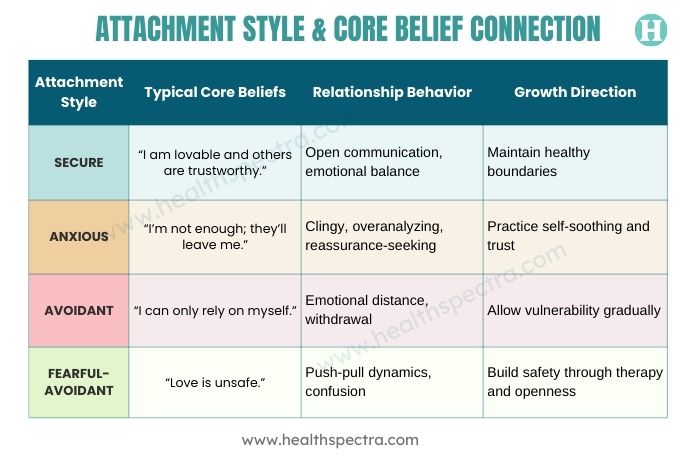
Read More: Psychology of Attachment Styles and How They Affect Relationships
The Relationship Selection Bias

Our core beliefs shape how we see the world and who we choose to love. Psychologists call this a relationship selection bias: the unconscious tendency to pick partners who confirm what we already believe about ourselves and relationships.
We’re Attracted to Familiar Beliefs
We’re drawn to what feels familiar, not necessarily what’s healthy. If you grew up believing “I’m unworthy,” you might feel chemistry with someone distant or critical because it fits your emotional blueprint.
Familiarity Feels Like Chemistry
What feels like “instant connection” often mirrors old emotional dynamics. Familiar pain can masquerade as passion because the brain links recognition with safety, even when it leads to hurt.
Why Healthy People Feel “Boring”
When someone treats you with steady care and respect, it can feel foreign or flat. This is because your nervous system has been trained to associate excitement with inconsistency or emotional chase.
The Repetition Compulsion
Psychologists call this the repetition compulsion, which means our drive to replay painful dynamics in hopes of rewriting them. But instead of healing, we often end up reinforcing the same wounds.
Breaking the Pattern
Awareness is the first step. By noticing who feels “magnetic” and asking why, you can start questioning whether attraction stems from comfort or genuine compatibility. Understanding your core beliefs lets you make conscious choices, turning your love life from a loop of repetition into a space for real connection and growth.
Read More: Why Personal Growth is Crucial in Long-Term Relationships
Beliefs Create Relationship Self-Fulfilling Prophecies

Our thoughts have a silent power over the reality we create, especially in love. A self-fulfilling prophecy occurs when a positive or negative belief subtly shapes how we act and talk, and how we interpret situations, thereby affecting others’ responses and fulfilling that belief.
In relationships, these cycles can trap people into fate-like patterns when, in fact, they are the product of unexamined expectations.
Testing Behaviors Driven by Beliefs
The person with the belief that “People always leave” may continuously test the partner, such as by checking phones, seeking reassurance, or becoming overly cautious about emotional closeness. These defensive behaviors, even when intended to prevent hurt, can make the relationship tense or exhausting and slowly push a partner away.
Partner Responds to the Behavior
Eventually, the partner starts reacting to this pressure. Feeling mistrusted or smothered, he/she may withdraw emotionally or physically in order to restore the balance.
Response Confirms the Belief
That distance then becomes proof, and they think, “See? I knew they’d leave.” The belief gets reinforced, and the same painful pattern continues in future relationships, deepening the sense of hopelessness.
Example of the Cycle
Now, imagine someone who believes, “I’m unlovable.” Afraid, they withhold affection, overanalyze their partner’s behavior, or expect rejection. Their partner feels this emotional wall and feels shut out. As things cool, it confirms the person’s fear, without realizing their guarded behavior contributed to the outcome.
When Two Sets of Beliefs Interact
It’s not one belief system that shapes relationships, but two. If both partners have unresolved fears, say one fearing abandonment and the other fearing control, they can constantly be setting each other off, creating misunderstandings that neither intended.
Breaking the Cycle
Awareness breaks the loop. By recognizing this connection, you can pause after becoming aware and make a different choice in response. Replacing fear-based thoughts with affirmations such as “I am safe and deserving of love” may invite more trust and openness.
They serve as a kind of blueprint for relationships. You change the belief, and you start to change the unfolding story from one of self-fulfilling prophecies toward self-healing possibilities.
Read More: How Conflict Can Strengthen Your Relationship
Changing Relationship Beliefs

Our beliefs about love and relationships shape, in silence, how we connect, communicate, and respond to others.
These beliefs are usually set early in life and either nourish or destroy intimacy. Learning to identify and change them helps in forming healthier, more fulfilling relationships.
Understanding and Identifying Beliefs
Our beliefs about relationships typically stem from early-life experiences, including family dynamics and past romantic interactions. In order to change them, the first step is to identify what those beliefs actually are.
Consider the patterns in your relationships: do you fear rejection or mistrust, or do you try to control the outcomes of your interactions with others? Review your relationship history for recurring emotional themes.
Ask yourself, “What do I expect will happen when I get close to someone?” or “What do I believe about love and trust?” By recognizing these beliefs, a foundation for change can be established.
Using the Relationship as a Learning Space
Current relationships remain invaluable for testing and reshaping beliefs. Consider your relationship as a kind of “laboratory” where you can observe how your thoughts shape your emotions and actions.
You have a belief, say, like “People always leave,” and if in the course of your relationship your partner distances from you, you may retreat in anticipation of rejection-a self-fulfilling prophecy. Instead, use awareness to stop in your tracks and respond differently, talk about your concern rather than retreating.
Communicating About Beliefs
Share your views with your partner to bring understanding and build trust. Explain what you are working on and what triggers certain feelings or reactions; this openness will bring emotional safety and invite your partner to be open about his beliefs and fears. This, too, must be done gently: avoid turning discussions into blame or therapy sessions.
Behavioral Experiments for Change
Once you have identified your beliefs, conduct small behavioral experiments. If your belief says, “I will get rejected if I show vulnerability,” express a small need and see your partner’s reaction. When you find that it is not confirmed, the belief starts to soften. These gradual steps help the brain make new emotional associations.
Therapy Options and Progress Timeline
Both individual and couples therapy may help challenge one’s relationship beliefs. In individual therapy, you focus on your personal patterns; in couples therapy, both partners explore how their beliefs interact.
It takes time to change deeply held beliefs, usually several months of consistent awareness and effort, but early improvements in emotional closeness, trust, and communication can be experienced along the way.
Identifying, testing, and replacing limiting beliefs makes a relationship healthier and more authentic, based on present experiences rather than old fears.
Timeline for Seeing Relationship Improvements
- Change does not occur overnight; it happens over weeks and may become emotionally visible after diligent practice.
- Deeper belief changes take months with consistent practice and reflection.
- Couples might have smoother communication and less conflict at an early stage.
- Patience and ongoing awareness sustain long-term transformation.
Read More: Effective Communication Tips for a Healthier Relationship
Conclusion

Breaking long-standing relationship patterns involves a process of understanding and reshaping core beliefs. Those beliefs might be deeply embedded, but they are not permanent truths; they are stories your mind learned in order to protect you. But the moment you begin questioning and challenging them, change is possible.
You are never doomed to repeat the same painful dynamics or attract the same type of partner. You can choose differently with awareness, patience, and courage in every moment: respond with trust, not fear; openness, not withdrawal.
It takes continuous effort to shift these internal narratives, but with each conscious choice, you rewire your emotional patterns a bit more. Your relationship future is written not by your past but in every moment of now when you act from self-awareness and compassion.
Working on one’s beliefs is how one reclaims control over one’s emotional life and opens oneself up to supportive, secure relationships that are truly fulfilling. It doesn’t happen overnight, but it does begin with belief.
FAQ Section

Here are some common questions about changing relationship beliefs and how this inner work can transform connection, communication, and emotional growth.
Will my partner need to change their beliefs too?
Ideally, yes, because both partners bring their own beliefs about relationships into the dynamic. However, change starts with you. When one person begins to recognize and shift their limiting beliefs, it often encourages healthier communication and emotional safety, which, in turn, naturally influences the other partner’s behavior and mindset.
While you can’t force your partner to change, your self-awareness and emotional growth can inspire a ripple effect in the relationship. In some cases, couples therapy helps both partners uncover their core beliefs and create shared understanding, leading to more balanced and fulfilling connections.
Should I work on beliefs before or during a relationship?
It’s never too early, or too late, to explore your beliefs. Working on them before a relationship helps you understand your emotional patterns and prevents repeating unhealthy dynamics. But relationships often act as mirrors, revealing hidden fears or assumptions.
So, even during a relationship, belief work is valuable. When you recognize your triggers or negative thought cycles, you can respond with awareness rather than defensiveness. The key is to see each experience as an opportunity for growth. Whether single or partnered, examining your beliefs brings clarity and improves emotional intimacy and communication.
Can relationship beliefs change without therapy?
Yes, they can, but it takes self-reflection and consistent effort. Therapy offers structure and support, but personal belief change can also happen through journaling, mindfulness, and conscious communication. Paying attention to your thoughts, challenging negative assumptions, and practicing new emotional responses gradually rewires old patterns.
For example, replacing “I’m not worthy of love” with “I deserve healthy, mutual love” helps shift your mindset over time. Books, podcasts, and trusted friends can also support your growth. While therapy speeds up the process, self-awareness and practice are powerful tools for reshaping your beliefs and creating healthier relationships.
References
- Masciana, L. (2024, October 2). Why your relationship patterns Keep Repeating (And How to break the Cycle) — Mind Jardin. Mind Jardin.
- Lcsw, E. G. (2020, February 25). 4 REASONS YOU’RE REPEATING UNHEALTHY FAMILY PATTERNS. J Proactive.
- Cooks-Campbell, A. (2025, January 21). Shift your core beliefs to unlock your full potential. BetterUp.
- Van Tonder, C., & Van Tonder, C. (2025, February 4). Understanding the three types of core beliefs. Jenine Smith Clinical Psychologists | Clinical Psychologists Based in Cape Town.
- Sjcarlson. (2017, November 4). Using core beliefs to create authentic characters. Sarah J. Carlson.
- Lcsw, A. R. P. (2020, January 5). How can you change your core beliefs when they limit you? Psychology Today.
- Antiloneliness. (n.d.).
- Core Beliefs in therapy: Understanding and Transforming Deep-Rooted Patterns | Berries. (n.d.)
- Core Beliefs and Cognitive Behavioral Therapy | dummies. (n.d.)
- Joel, S., & MacDonald, G. (2021). We’re Not That Choosy: Emerging Evidence of a Progression Bias in Romantic Relationships. Personality and Social Psychology Review, 25(4), 317–343.
- Lcpc, B. T. (2024, September 3). Understanding Core Beliefs: How Confirmation Bias Shapes Our Reality. Counseling Center.
- Belief driven formulation. (n.d.). Psychology Tools.
- Hummingbird Clinic. (2025, July 12). Self-Fulfilling Prophecy – Hummingbird Psychotherapy Clinic. Hummingbird Psychotherapy Clinic.
- Eddins, R. (2025, August 13). Uncover your core beliefs so you can change them. Eddins Counseling & Therapy Group – Houston & Sugar Land, TX
- Lcsw, A. R. P. (2020b, January 5). How can you change your core beliefs when they limit you? Psychology Today.
- Grants, C. (2025, May 18). Core Beliefs — Lotus therapy. Lotus Therapy.
- Overcome anxious thoughts and limiting beliefs. (2025, February 11). Better Your Life.
In this Article